
Some books come to you instead of the other way around. Susanna Kaysen’s Girl, Interrupted, a thin, 156-page memoir that appears in used bookstores for almost nothing, is casually passed between friends, and then quietly refuses to leave, has been just that for many readers over the past thirty years. It was published in 1993 and describes Kaysen’s approximately eighteen-month stay at McLean Hospital in Belmont, Massachusetts, starting in April 1967 when she was eighteen years old. She was sent there after attempting suicide and had a thirty-minute consultation with a psychiatrist she had never seen before. The thirty minutes is a detail that keeps coming up throughout the book like a splinter that won’t go away.
McLean Hospital is located on a Belmont campus that, depending on the season, resembles a liberal arts college rather than a mental health facility. Kaysen is aware of this difference and writes about the place with the objectivity of an anthropologist, cataloging the routines, hierarchies, and personalities of her floor with an accuracy that verges on clinical. We meet Daisy, who comes every November, eats only chicken in her one room, and keeps the carcasses; Lisa, who wears her sociopath diagnosis like a badge; and Georgina, Kaysen’s roommate and one of the book’s more stabilizing presences. The reader is not intended to feel reassured by these characters. They are distinct, peculiar, and meticulously drawn to the point where their disappearance from the story’s subsequent pages feels like a tiny, silent loss.
Kaysen’s insistence on examining the mechanisms of her own institutionalization is what elevates Girl, Interrupted beyond a period piece. With the assistance of a lawyer, she was able to obtain her hospital file years later, and parts of it can be found throughout the book, including intake forms, doctor’s notes, and letters with time stamps that conflict with some official accounts of her treatment. She provides the reader with a mathematical justification for why her first consultation lasted twenty minutes rather than three hours as the psychiatrist claimed in one of the book’s most striking chapters. The calculations are meticulous. It’s a damning conclusion. Then she simply says, “Now you believe me.” Reading that line makes it difficult to avoid experiencing the unique annoyance of someone who has been told for years that their perception of reality is untrustworthy.
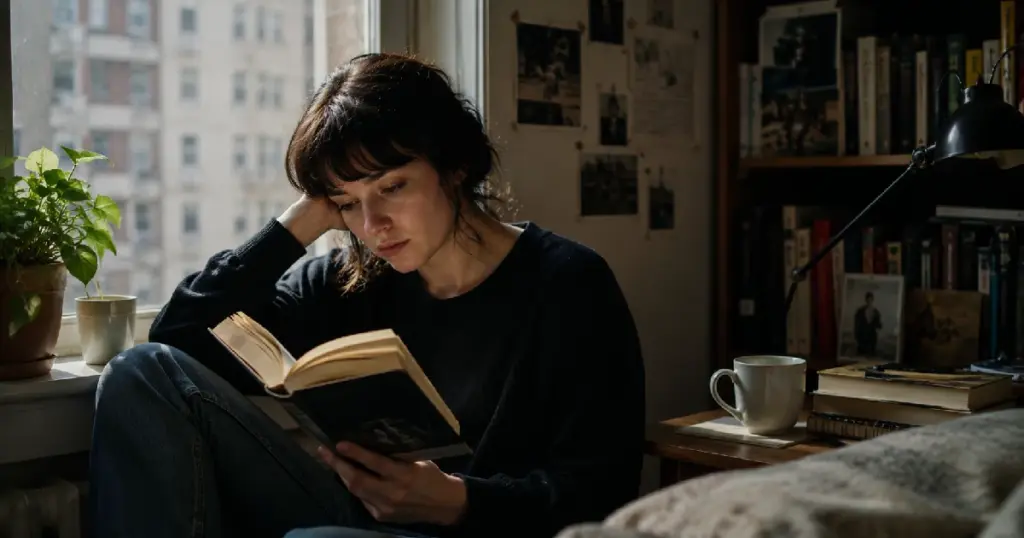
In the 1960s, the diagnosis of borderline personality disorder carried a certain weight that it may still carry today. Kaysen’s refusal to attend college, her ambivalence about marriage, and her rebellion against midcentury expectations of femininity were all understandable to her psychiatrists at McLean as symptoms rather than decisions. According to an analyst cited in the book, diagnosis patterns change over time: hysterics in one era, psychoneurotics in another, and borderlines in a subsequent one. Kaysen was aware of this. She writes that she considered herself to be genuinely unsuited to the social and educational systems that surrounded her. The issue was that no one in her immediate vicinity shared her framing. Reading the memoir in 2026 gives me the impression that this particular debate is still unresolved, with the issue of who gets to define what constitutes disordered thinking still bearing the same unequal weight as it did in 1967.
The book was on the New York Times hardcover bestseller list for eleven weeks and the paperback list for twenty-three weeks. Then came the James Mangold-directed movie from 1999, which gave Angelina Jolie her big break and presented Kaysen’s story in a completely different way to a much larger audience. By most accounts, the film is a more traditional work, more dramatic, more resolved, and more focused on providing the audience with a compelling storyline. All of that is resisted in the book. The shapelessness of a prolonged hospital stay, all the ordinary days that don’t make the page, and the gradual erosion of any trustworthy sense of time passing are all mimicked in its vignette format. Kaysen yells, “It’s my time and I need to know how much it was,” when she awakens from anesthesia during a dental procedure and no one tells her how long she was unconscious. In print, the scene seems almost comical. It’s completely different when a two-year institutionalization is mandated following a half-hour discussion.
It’s important to remember that the memoir was a part of a larger cultural phenomenon. One year later, Elizabeth Wurtzel’s Prozac Nation followed, and together they created what would come to be known as the genre of young women’s memoirs about mental illness, which were met with equal parts admiration and suspicion. Both books were followed by accusations of narcissism. Accusations may reveal more about the reader’s unease than any writer’s shortcomings.
The story has now made it to the stage in June 2026. An off-Broadway musical adaptation of Girl, Interrupted has debuted at The Public Theater. It took years to develop, was postponed due to a pandemic, and its songs were eventually released as Aimee Mann’s 2021 album Queens of the Summer Hotel. It’s genuinely unclear if theater can hold what the page does. The gaps in the official record that are never filled, the silences, and the blank spaces in Kaysen’s book all contribute to its effectiveness. By its very nature, a stage production fills in. Instead of giving you space to find yourself in it, it shows you the thing. This is directly addressed in the opening lines of the book: “People ask, How did you get in there? They genuinely want to know if they will probably wind up there as well. On a stage, that question never goes away.

Chloe Olliver is senior editor at vclib.org, where she leads editorial coverage of literary criticism, political commentary, cultural analysis, and the evolving relationship between literature and public life across New York City and beyond. With a career spanning the intersection of literary journalism, political commentary, and educational publishing, Chloe brings both rigorous research discipline, in-depth knowledge, experience, and an accessible editorial voice to subjects that most readers find thought-provoking and culturally significant.