
In 2012, Jacqueline Harpman passed away. She spent decades working as a psychoanalyst in Brussels, wrote over fifteen novels in French, and won the Prix Réicis in 1996, one of France’s most prestigious literary honors. She had, by most accounts, lived a full and distinguished life. Then, in 2022 or 2023, a teenage girl in the United States made a brief film about a slim, bizarre novel that Harpman had published in 1995. Then someone else followed suit. Then thousands more. I Who Have Never Known Men has sold over 100,000 copies in the US in a single year and has over 621,000 ratings on Goodreads. One of the most talked-about novelists of the decade is a deceased Belgian author who wrote in a language that most of her new readers don’t speak.
There is something very strange about that trajectory that is difficult to ignore. Around 3,000 people have rated Harpman’s second-best-known book, Orlanda, which was the one that actually won her the Prix Réicis. Another book, La Plage d’Ostende, has about 410. It’s not a literary gap. It’s a canyon. Whatever happened to I Who Have Never Known Men, it was almost entirely due to the way younger readers interacted with one another online and had very little to do with the approval of the literary establishment.
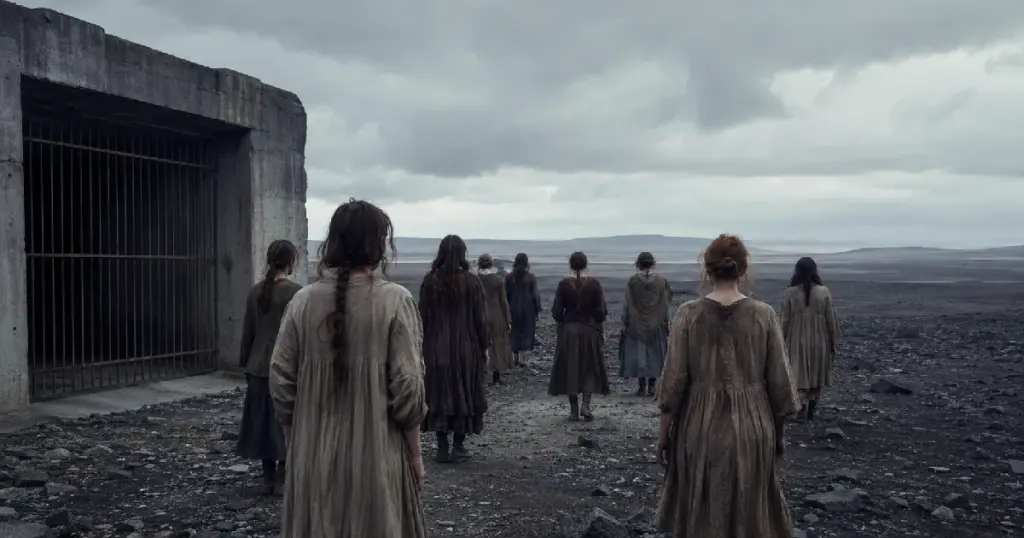
In the book, forty women—thirty-nine adults and one unidentified young girl—are imprisoned in an underground cage by silent male guards who never provide an explanation. Nobody is aware of how they arrived. What happened to the world above is unknown. One day, when an alarm goes off and the keys fall, almost unintentionally, into the narrator’s hands, the guards vanish after enforcing their captivity silently and using whips if the women make too much contact with one another. The women discover emptiness above ground. A huge, barren plain. No answers, no animals, no people. Movement, grief, survival, and the slow, patient process of creating meaning out of nothing.
Once you’ve held it, the popularity of Jacqueline Harpman’s book makes sense in part because of that simple, brutal premise. Even after the women manage to flee, readers describe a sense of the walls closing in. This book has a certain kind of dread that doesn’t go away when the cage opens. Harpman seems to be arguing that freedom is not a destination. You must uphold this condition in the face of an uncaring universe.
Some of that burden was carried by Harpman’s own life. She was born in 1929 and spent a portion of her early years in Casablanca after fleeing Belgium with her Jewish family during the Nazi occupation. After a protracted illness, she began writing, published her first book in 1958, was awarded a Belgian literary prize almost immediately, and gave up fiction completely when her publisher passed away in 1962. Instead, she trained as a psychoanalyst for twenty years, earning her certification in 1980. She kept a private practice and wrote clinical essays on psychology and feminism. That internal understanding of memory and identity permeated everything she wrote when she went back to writing fiction in the late 1980s. The 1995 book I Who Have Never Known Men may be the best representation of it all: the absurdity, the exile, and the insistence on analyzing what the self truly is when devoid of all cultural markers.
The intriguing thing about this book’s viral reading moment is how accurately readers seem to be figuring out what Harpman was doing. Communities on BookTok refer to it as a “Generation Z Handmaid’s Tale,” which is somewhat accurate but also a bit off. Fundamentally, Atwood’s book is a political allegory that is distinct, pointed, and directed at particular systems. The book by Harpman is colder and stranger. Since the narrator has never known men, she lacks a framework for understanding the patriarchy she lives under and a vocabulary to describe the loss of freedom she is going through because she cannot recall what it was like to be free. She starts at zero and creates meaning. That is more Camus than Atwood; it is an existential struggle with absurdity that does not provide the reader with the consolation of a well-reasoned thesis.
This ambiguity is honestly reflected in responses on Reddit and Goodreads. The majority of readers describe it as the kind of book that lingers for months because they find it eerie and impossible to put down. It seems reasonable that some people find it slow and even annoying. There is no resolution in the book. The women emerge into emptiness, continue walking, discover other bunkers containing less fortunate corpses, and carry on. There isn’t a revelation at the conclusion, but there is love, grief, and a little, everyday warmth. Not everyone reads novels with the intention of sitting inside them, and that open wound is likely the point.
The fact that this reissue took place at all has a subtle significance. Publishers are generally wary of mid-list backlist titles from decades ago, particularly those that have been translated. It’s possible that the commercial argument—that social media accomplished what literary prizes couldn’t—became unavoidable due to the overwhelming amount of online attention. Before it was released again, the book was out of print for more than 25 years. It is currently selling more copies than it most likely did in the 1990s, reaching readers who may never have read any of Harpman’s other works.
It’s really unclear if that qualifies as a full legacy. In the English-speaking world, the remainder of her work is essentially unseen, which is both a loss and an invitation. It’s highly likely that someone with the psychological accuracy Harpman brought to I Who Have Never Known Men had more to say elsewhere. However, the one successful book is currently making a difference in the world. Walking across an empty planet in a cage, forty women wonder what it all means. That seems to hit differently in 2024. Harpman would not have been shocked.
