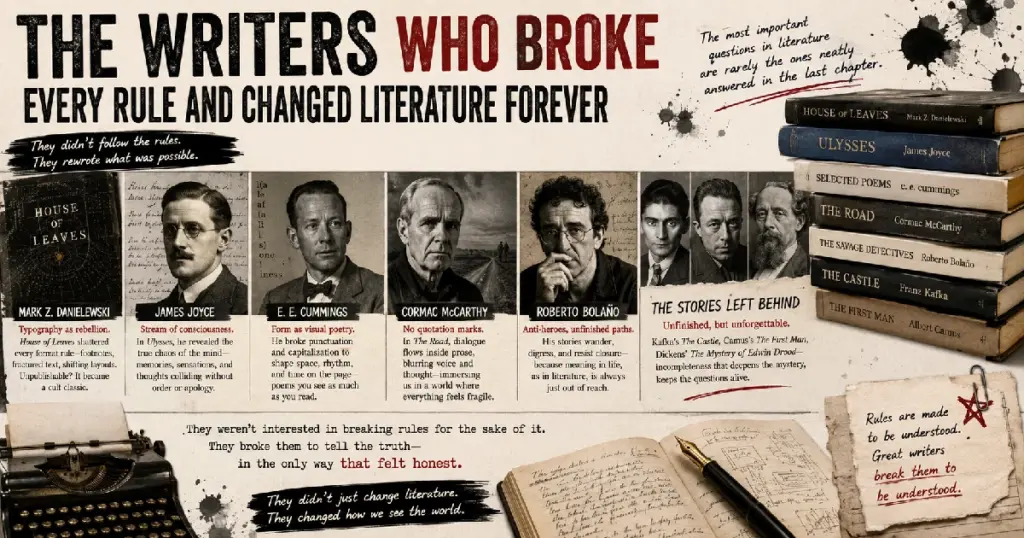
Somewhere on a shelf is a copy of House of Leaves that has been passed between at least a dozen readers; before the next person even opens it, the margins are already covered in handwriting. For a novel, that is not typical. However, House of Leaves is a unique book in which the typography appears to be falling apart at the seams, footnotes vie for space with the main narrative, and the text spirals across pages in fragments. When Mark Z. Danielewski published it in 2000, the conventional publishing wisdom at the time would have declared it unpublishable. Even unreadable. It developed into a cult phenomenon.
The rule-breaking manuscript that shouldn’t have worked and then did is a recurring theme in literary history that begins to feel less like coincidence and more like proof of something. The authors who looked at the established forms and felt they were insufficient for what they were truly trying to say were nearly always the ones who altered literature the most. There was no artistic posturing involved in the rebellion. It was essential.
Because he was tired of traditional storytelling, James Joyce did not include stream of consciousness in Ulysses. He took this action because he genuinely believed that the traditional novel’s orderly, sequential, cause-and-effect structure was a lie about how human minds truly function, lurching between memory and sensation, between the insignificant and the enormous, without clear transitions or resolution. The book is infamously challenging. Some of it is still genuinely disputed by academics. Even in the sections where the grammar has completely vanished, you can sense something genuine happening on the page when you pick it up. That emotion is not coincidental.
For example, Cummings removed capitalization and standard punctuation from his poetry, which irritated critics in the 1920s in the same way that things frequently seem annoying right before they seem inevitable. It turned out that he was closely observing how the eye moves across a line of text and how the space surrounding words affects how long it takes to read them. On paper, his poems have a sculptural, almost architectural appearance. It usually depends a lot on your willingness to slow down enough to see what he’s really doing with the white space, which will determine whether you find them beautiful or confusing.
Another type of rule-breaker is Cormac McCarthy, who is more complete in some aspects but quieter in others. He completely stopped using quotation marks, allowing dialogue to emerge from prose without the customary cues. In The Road, two characters traveling through a devastated American landscape converse with one another in phrases that almost perfectly fit the surrounding description. It shouldn’t function as effectively as it does. The absence of those tiny marks surrounding speech creates a world where the distinction between voice and thought, between the internal and the external, has become a little less certain, giving the impression that the typographical choice is performing actual emotional labor. This is precisely the kind of world that The Road is depicting, of course.
When examining all of these authors, it’s important to note that those whose formal experiments persisted had little interest in the experiments themselves. This point is carefully made by Wendy Lesser in her book Why I Read: the books that changed the world were not motivated by a desire to innovate. They would feel weaker than they do if that were the case. When it succeeds, the author’s attempt to convey the truth in a way that the preexisting forms won’t permit results in the novelty of form. The experiment collapses under its own self-consciousness when it doesn’t work, and there are many instances where it doesn’t, leaving behind something that reads more like a demonstration than a novel.
Roberto Bolaño had a particularly clear understanding of this distinction. His portrayal of writers who are infatuated with their own rebelliousness is a dry comedy, and his Chilean characters meander through unfinished literary movements and absurd avant-garde journals. However, Bolaño’s own formal decisions, such as the unresolved novels, the narrators who stray, and the digressive plots, never feel like a showpiece. They seem to be an honest description of how meaning functions in reality—incompletely, in a circle, with important details always just out of reach.
Kafka did not finish The Castle. The First Man’s rough and annotated manuscript was in Camus’s bag when he passed away in a car accident in 1960. When Dickens passed away, The Mystery of Edwin Drood was still in the middle of serialization, leaving readers to speculate about an unsolved mystery. It’s difficult to ignore the fact that some of the pieces that never quite closed are the ones that feel the most alive. Over time, their incompleteness became a part of their meaning, serving as a reminder that the most important questions in literature are rarely those that are neatly resolved in the last chapter.
Most of the authors who defied all conventions and permanently altered literature were not comfortable individuals. They were authors who sought something more authentic, even if it meant creating work that perplexed or alienated their peers, because they believed the existing forms to be dishonest. They didn’t just break the rules. The breaking wasn’t either.
