
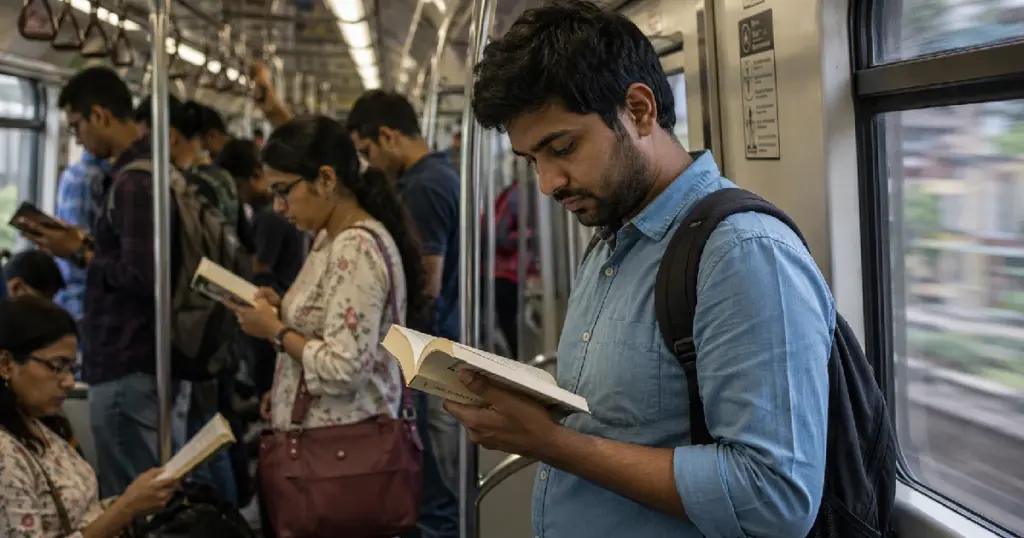
Someone is most likely finishing a chapter on a packed train somewhere in New Delhi right now. The scene is small and unremarkable, and that’s precisely the point. In India, reading is just another Tuesday; it’s not a special occasion. More information about the nation’s top spot in the world reading rankings can be found in that one picture than in any spreadsheet.
On their own, the numbers are powerful enough. Indians read for 10 hours and 42 minutes a week on average, more than any other country. China completes the top three at about eight hours, followed by Thailand at nine hours and twenty-four minutes. The figures originate from a widely cited 2016 dataset published by The Independent, and subsequent reporting has largely confirmed the pattern holds. These are not haphazard estimates taken from a marketing survey.
What the numbers don’t tell you is what’s fascinating. The amount of time spent reading and the number of books actually completed prove to be two very different indicators of a culture of reading. The United States surpasses India in the number of books completed annually, 17 to 16, even though it ranks 42nd in weekly hours at just 5 hours and 42 minutes. It’s a tiny but significant gap. It appears that Americans read in quick, effective bursts. Indians stay behind. Although it’s tempting to speculate, it’s difficult to say with certainty whether that reflects commuter habits, genre preference, or something more cultural.
Convenience and leisure time are not the main factors contributing to India’s dominance, nor did it happen overnight. From the ancient Sanskrit epics to the vast contemporary fiction currently occupying bookstore shelves in Bangalore and Mumbai, the nation has a storytelling heritage that dates back thousands of years. In addition to having one of the world’s largest English-speaking populations, readers there have access to the whole English-language publishing industry as well as a rich local canon. It’s a unique combination that is probably difficult for many other countries to imitate.
Europe has a more subdued narrative. Although Switzerland isn’t at the top of any headline rankings, almost half of its citizens read at least four books annually, and a full quarter read ten or more. This unglamorous consistency may be more significant than any one noteworthy statistic. Ireland, on the other hand, proudly displays its literary reputation. Yes, James Joyce still has a lot of influence, but government-funded literacy initiatives and a robust publishing sector have kept storytelling ingrained in Irish culture, not just on tourist placards outside historic pubs.
Before anyone interprets America’s ranking incorrectly, it is worthwhile to take another look at it. Even though five hours and forty-two minutes a week doesn’t seem like much compared to ten or more hours in India, it still adds up to hundreds of hours a year, which is enough to finish dozens of books. It’s not true that Americans no longer read. It’s that reading still manages to maintain its position in the face of an unprecedented amount of other content, including streaming services and never-ending scrolling. That may be even more impressive than the raw figure would indicate.
Here, format is also important. Even though e-readers and audiobooks are gradually gaining ground, print books continue to be the most popular in the United States. In a recent survey year, only roughly 9% of readers worldwide said they only read books in digital format, and 23% said they didn’t read any books at all. The remainder were divided fairly evenly between readers who preferred print and those who didn’t care about format. Despite years of predictions that the printed page would disappear, there’s something almost comforting about that.
Beneath all of this, there is a pattern that is difficult to ignore. The nations that read the most typically view books as more of an infrastructure than a form of entertainment, incorporating them into daily commuting, education, and spirituality. Researchers continue to circle around the question of whether that translates into quantifiable economic or civic benefits. However, it’s hard to get rid of the impression that a country’s reading habits reveal something subtle and enduring about its way of thinking.
