
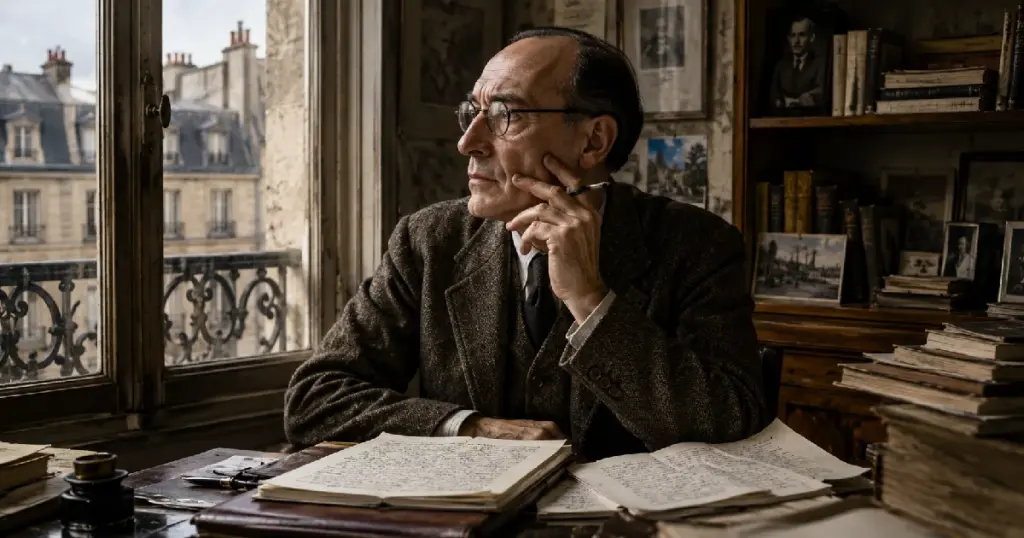
It’s easy to picture André Gide there a century ago, restless and unhappy, figuring out some personal contradiction on paper before he’d even finished living it, as you stroll through the Marais in Paris on a calm afternoon. That’s what he did for the majority of his life. One confessional narrator at a time, in a way, writing himself into existence. The feeling that a real person is debating with himself on every page of his novels is what sticks out when reading them today, rather than the plot, which is frequently thin by design.
The Protestant austerity that Gide’s mother instilled in him is evident throughout his fiction, primarily as a means of escape. He received uneven instruction, lost his father at a young age, and developed a lifelong bond with his cousin Madeleine Rondeaux. It’s tempting to read his whole body of work as a single, protracted negotiation with that relationship, and to be honest, that reading is more resilient than most.
Something seems to have opened up in him during his first visit to North Africa in 1893. Gide began to accept his own homosexuality away from the moral framework he had grown up within, and the prose poem that followed, Fruits of the Earth, reads like a man attempting to talk himself into freedom. When the book was published in 1897, it hardly sold. Then the war came to an end, and a whole generation of postwar people found exactly what they were searching for: permission. It turns out that timing is just as important in literature as it is elsewhere.
The Immoralist, Strait Is the Gate, and The Pastoral Symphony were the works that most readers truly recall. These are not neat tales. They are based on narrators who divulge much more about their own self-deception than they intend to. They are told in a style Gide dubbed the décit, which is straightforward on the outside but subtly devastating on the inside. It’s possible that Gide never completely resolved the conflict between his love for Madeleine and his desire for a level of freedom that she was unable to provide, and these books read more like someone resolving the conflict in real time than someone who had already done so.
Then comes The Counterfeiters, which Gide never explicitly referred to as a novel, as though everything that had come before it had been rehearsal. Five Parisian families are entangled in this expansive, purposefully messy book through adultery, counterfeit money, and a teenage suicide pact that was taken from a real crime case that Gide had read about in the newspapers. Edouard, the narrator of a book about writing novels, keeps losing control of his own narrative, which appears to be precisely the point. Fiction should feel as unresolved as life, according to Gide. People who study this stuff for a living continue to argue over whether he really pulled that off, and it’s still unclear if there is a definitive answer.
His fiction changed with the same restlessness as his politics. In 1936, he traveled to the Soviet Union in search of the egalitarian future he had dreamed of. He returned home disappointed and wrote openly about the experience, despite the fact that it cost him left-leaning friendships. That candor has an almost stubborn quality, a refusal to defend a conviction simply because he had once publicly expressed it.
Gide had survived the majority of the controversy his earlier work caused by the time the Nobel committee acknowledged him in 1947. Even close friends had once attacked him because of Corydon, his defense of homosexuality. The same tendency toward unwavering self-examination that made him controversial was now being referred to as moral courage decades later. Seeing that reversal occur over the course of a single lifetime reveals something about how slowly literary culture actually advances and how much patience its proponents occasionally need.
