
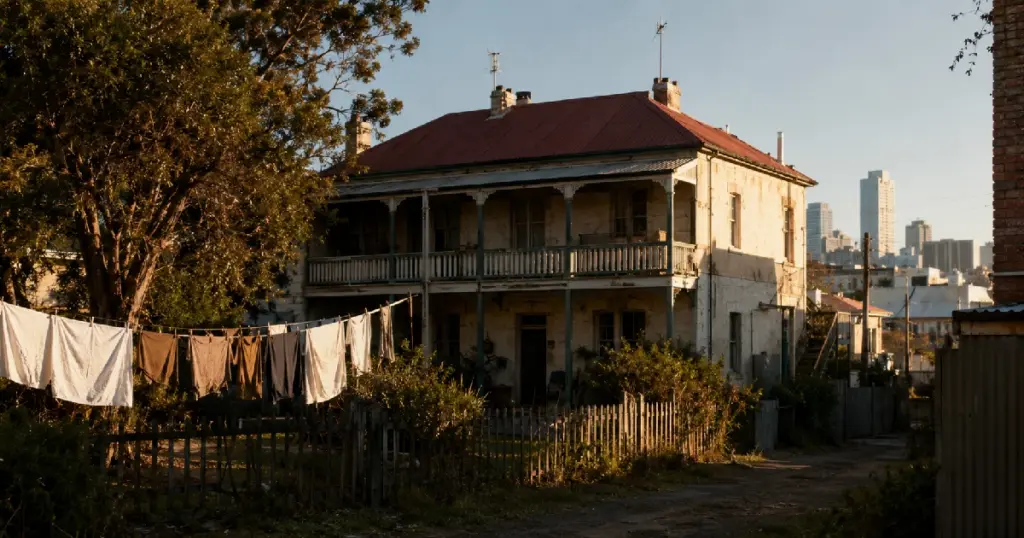
There’s a particular kind of literary experience that sneaks up on you. Not the kind where a novel announces its own greatness from the first paragraph, but the kind where you finish the last page, sit very still for a moment, and realize that something has quietly shifted. That’s the experience Tim Winton’s novels tend to produce, and Cloudstreet, his sprawling 1991 saga of two working-class families sharing a house in Perth over two decades, is perhaps the most complete example of what he can do when he’s working at full stretch.
Cloudstreet begins in 1943, arriving without ceremony into the life of Sam Pickles — a man defined less by ambition than by a peculiar gravitational pull toward bad luck. He loses fingers in a work accident. He gambles money that isn’t really his. When a relative dies and leaves him a house and two thousand pounds in Perth, it seems like fortune has finally changed direction. Then he gambles the cash away overnight. The house, number 1 Cloud Street, becomes both the family’s salvation and its trap, bound by a twenty-year condition preventing its sale. You almost want to laugh. Almost.
Into the other half of this enormous, slightly collapsing house come the Lambs — the Pickles’ near-perfect opposites in every observable way. Where the Pickles drift and stumble and drink, the Lambs work. Oriel, the matriarch, sets up a grocery store in their section of the house and runs it with the focused determination of someone who has decided that survival is a moral position. Her son Quick carries guilt the way some people carry a coat they never take off. And Fish — the boy who was pulled from the water after a fishing accident, technically saved but left with only part of his mind — becomes the novel’s haunting, unresolved presence, the character who lingers longest after the book is closed.
What Winton does in Cloudstreet that many writers would struggle to manage is sustain genuine intimacy across a very large cast over a very long timeline without anyone feeling like furniture. Rose Pickles grows from a girl doing her mother’s parenting for her into a young woman desperately seeking the exit from a family she’s learned to resent. Quick Lamb leaves, comes back changed, falls in love. The two families — not quite neighbors, not quite family — share births and deaths and hangovers and arguments across a no-man’s land of a corridor that slowly, inevitably, becomes less of a boundary with each passing year.
It’s hard not to notice how much Perth itself functions as a character in this novel. Winton grew up in Western Australia, and the book reads at times like a love letter to one of the world’s most geographically isolated cities — a place that was still genuinely small when the Pickles and Lambs arrived, then grew and modernized around them while the old house on Cloud Street held its ground like a stubborn relative refusing to acknowledge time. Train lines expand. Buildings go modern. The city pushes outward into suburbia. And there’s that house, getting older, holding all these people inside it.
The novel isn’t all grim realism, either — Winton has a taste for magical elements that he deploys with restraint rather than spectacle. A windowless room in the house seems to trap something from the past. An elderly pig in the garden reportedly speaks. A figure described simply as a “blackfella” appears at pivotal moments, offering cryptic guidance, carrying the weight of a much older Australia pressing against the edges of this domestic story. These elements don’t feel decorative. They feel necessary, as if the realistic surface of the novel needed somewhere to breathe.
Reading Cloudstreet requires a certain patience with Winton’s language, which is unashamedly and specifically Australian. He writes dialogue phonetically — “carn” for “come on,” “dreckly” for “directly,” “youse” as a perfectly natural plural — and strips out inverted commas entirely, blurring the line between spoken words and unspoken thought. For readers unfamiliar with Australian vernacular, particularly the blunt, clipped rhythms of mid-century working-class speech, this takes some adjustment. It’s possible that American or British readers lose something in those early chapters simply fighting the style. But push through, and the voice becomes its own reward.
What makes Tim Winton’s novels worth returning to — and Cloudstreet rewards a second reading more than most — is a quality that’s difficult to name precisely. It has something to do with the way he treats ordinary people as worthy of serious, unhurried attention. These are not heroic families. They’re flawed and difficult and often disappointing to each other. Still, Winton watches them with something close to tenderness, and that feeling transfers. By the end of four hundred pages, you’ve lived in that house on Cloud Street long enough that leaving it feels like a genuine loss.
