
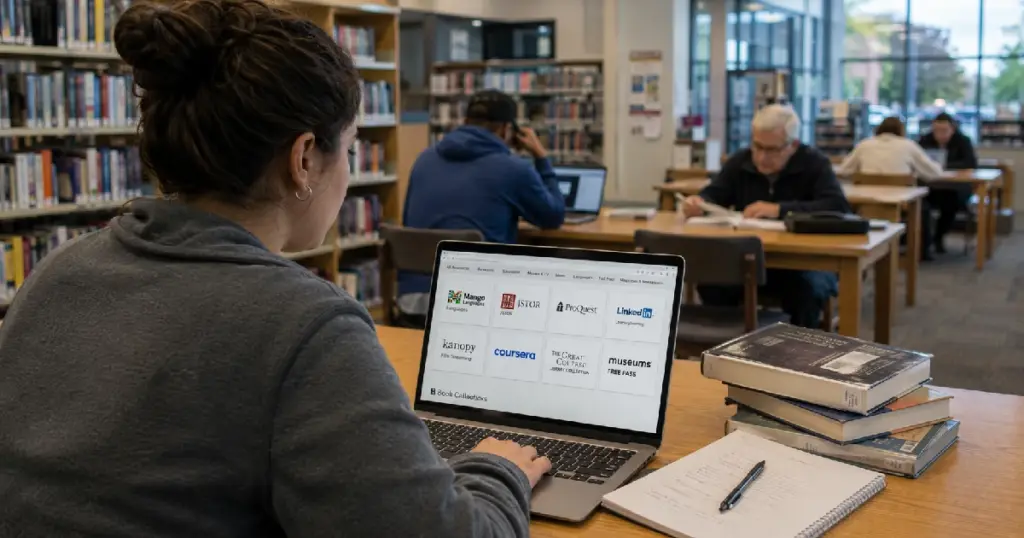
Paying for something you already had causes a certain kind of annoyance. Most people, if pressed, would describe a library as a place to borrow books. Maybe DVDs. A quiet room with long tables and that distinct smell — something between old paper and central air conditioning. That description isn’t wrong, exactly. It’s so unfinished that it might as well be somewhere else.
The digital layer that now sits beneath most public library websites is enormous, and almost nobody talks about it. Buried a few tabs deep, past the hours of operation and the upcoming storytime schedule, are tools that would cost the average person real money if purchased privately. Language-learning platforms like Mango Languages, which runs roughly $180 annually if you subscribe on your own. Access to scholarly databases such as JSTOR or ProQuest can cost individual users hundreds of dollars annually. streaming services for movies and documentaries. platforms for online education that offer thousands of courses for professional development. museum passes that provide free admission to establishments that charge $25 or more per visit. With a library card—which most people only use to take a paperback off the shelf—you can do all of this for free.
Libraries may not have been particularly aggressive in promoting this. The resources that greet you when you walk through a branch on a Wednesday morning, such as the book displays, reading suggestions, and flyer for the Saturday craft program, don’t mention that you could start a free project management certification course right away at home. From the outside, it appears to be a serious communication issue. Libraries operate on public funding and a certain institutional modesty, and neither tends to produce loud advertising campaigns.
The fact that their library card grants access to databases, online courses, and museum passes surprises a lot of Valley Cottage Library users. That surprise is telling. The services that Valley Cottage offers are not unique; rather, they are a good representation of what a mid-sized branch library currently offers. As a result, there is a significant and generally consistent discrepancy between what people are aware of and what is actually available. In actuality, the surprise is that it continues to occur. Every year, people unintentionally come across these resources—whether it’s through a flyer, a casual mention from a librarian, or a Google search that takes them to a page they had never visited before.
Although the student use case is simple, it’s important to be precise. A junior in college who needs access to peer-reviewed journals while studying for finals will discover that her university library has busy terminals and short hours. She doesn’t need a university login to access the database at her public library, which she can access from her laptop at two in the morning. That’s not a minor detail. Online course platforms accessible through the library can replace $30 to $50 monthly subscriptions for professionals in between jobs, such as those who are reskilling, changing careers, or attempting to establish themselves in a new industry. Thirty dollars doesn’t sound like much until you’re watching your savings and counting every expense. Additionally, the library’s digital resources frequently go far beyond a simple YouTube search for retirees who want to take up a hobby, such as watercolor painting, Italian cooking, or learning to read music.
If there is any frustration, it stems from how invisible everything is. The majority of people believe they are already familiar with the resources available at their library. That presumption shuts a door before anyone has a chance to see what’s behind it. In actuality, library websites—of which Valley Cottage Library’s is a good example—tend to be simple in appearance and packed with information; you have to actually browse the pages rather than just glance at them. Additionally, the majority of people don’t investigate them. They close the tab after checking the hours and perhaps looking for a particular book.
Watching this play out, it’s hard not to feel something close to genuine confusion. These are public resources, funded by taxes, designed for exactly the people who most need them, and yet the discovery process is almost entirely accidental. That seems like something worth fixing — though whether libraries have the budget or the mandate to fix it is genuinely unclear. Meanwhile, the more sensible solution is easier to understand. Go to the website. Not the home page. the page with resources. Go past the obvious stuff. It’s likely that something beneficial that you’ve been paying for elsewhere is waiting for you.
The assumption that libraries are just for books is outdated enough to be almost quaint. It’s still the dominant assumption, though. That gap — between what libraries now offer and what people believe they offer — is probably costing ordinary people more than they realize, both in money spent on things they didn’t need to buy and in opportunities sitting unused on a webpage they’ve never visited. That seems worth at least one afternoon of clicking around.
