
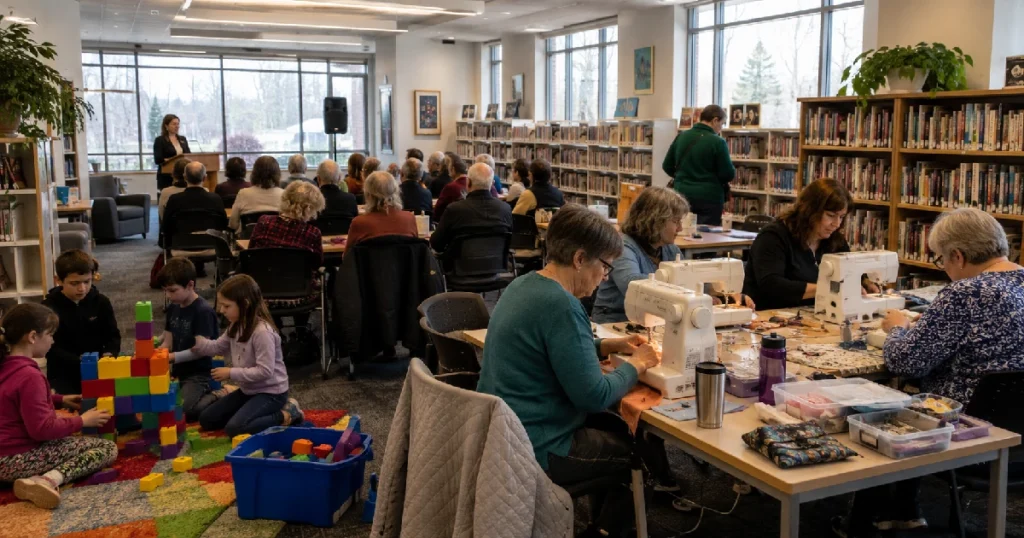
You might be taken aback by the noise when you enter a public library on a Thursday afternoon. Real human sound, not the old-fashioned sound of pages being shuffled and apologies being whispered. In a back room, a group of adults were bent over sewing machines. Kids spread out on the carpet, using foam blocks to construct something. A local writer is positioned at a podium in front of twelve seated neighbors who willingly came on a weekday to hear her discuss her book. The atmosphere is different from what most people recall, and the change feels important in ways that are difficult to identify right away.
For some time now, libraries have been quietly and unnoticedly doing this. There was no press release accompanying the change. It began as a reaction to financial constraints and later emerged as a sincere recognition among librarians that their buildings were already there, heated, and accessible to anyone without a credit card or cover charge. In a nation where coffee costs six dollars and community centers are becoming more and more pay-per-class, the library ended up filling a need that no one had anticipated.
This type of space is referred to by sociologists as the “third place.” Somewhere else, not at home or at work. Somewhere free and open to the public, where you are free to sit for as long as you like without being asked to leave. In the past, bars were considered third places. barbershops. diners. The claim is that suburban sprawl, reliance on cars, and the unrelenting commercialization of shared space have all contributed to the gradual erosion of these aspects of American life. Destinations, not locations, took their place. You leave, you pay, and you go. Unintentionally, libraries emerged as one of the final defenders against that trend.
A helpful illustration of this in action is Valley Cottage Library, which is tucked away in a small area of Rockland County, New York. At any given time, its calendar of events exhibits a sort of structured restlessness. Locals sell their handcrafted tea towels and pottery at craft fairs. Retirees, young parents, and people who appear to have wandered in from the parking lot with no specific plan are among the audiences that attend author talks, which occasionally feature fairly well-known writers and occasionally a neighbor who self-published a local history. Through workshops, book clubs, and neighborhood events, Valley Cottage Library connects locals. While this description may seem straightforward, it actually has a lot of meaning.
The adult education perspective is frequently disregarded in these discussions. If you stroll through on a weekday morning, you might come across a basic computer skills class attended by individuals in their sixties and seventies, many of whom are unfamiliar with government websites and online banking. Or a discreetly crowded resume workshop for people in between jobs who can’t afford to hire a career coach but need a printer and some advice. These programs are not glamorous. Attending the Excel basics session at the library is not mentioned on Twitter. However, the fact that every room is occupied seems to have some significance.
It’s difficult to ignore the fact that this change occurred roughly concurrently with many other things collapsing. The 2000s saw a decline in independent bookstores. Malls became hollow. After chain restaurants took over, many of them eventually closed as well, as was to be expected. As a result, many American towns have a built environment with just fewer places to be. Of course, libraries did not initiate that decline, but they did bear some of its effects. The library remained open, and people needed somewhere to go.
The notion that these spaces are only beneficial to society if they are free has merit. Free, not discounted, not subsidized. When money is excluded, the logic of belonging changes. Even in friendly coffee shops, being there is implicitly contingent upon making a purchase. You can be completely present at a library even if you don’t have anything. That may not seem noteworthy, but consider how few places in American public life still function that way.
It’s still unclear if this busy, multipurpose, town square-style library is a permanent feature or merely a temporary one. There is actual funding pressure. Once-easy ballot measures are now contested. Certain library systems have been forced to combine branches or reduce hours. The monthly genealogy club, the Tuesday morning knitting group, and the eleven-year-old ESL class are just a few examples of the strangely specific losses that can occur. These go unnoticed, and it’s not always clear from the outside what the community truly lost.
When a town loses its library’s programming, it typically doesn’t declare a social crisis. Book checkouts are still available at the library. The structure still stands. However, the space where the author talks used to take place is either locked or rented out to a yoga studio. After a year in the school gym, the craft fair is discontinued. The county program, which meets once a month twenty miles away, incorporates the adult education classes. The gathering disintegrates piece by piece. Investors, or at least the local government, frequently seems to think that these soft losses don’t have the same impact as school mergers or road closures. However, people take notice.
As all of this takes place, what’s really at risk is something akin to civic texture—the little, recurring interactions that give a neighborhood a sense of inhabitation rather than merely occupation. The woman you see every spring at the seed exchange at the library. Before attending art school, the child took a beginner watercolor course at the library. After his wife passed away, the elderly man began attending the author’s talks because he needed a place to spend Wednesday nights and discovered that he truly enjoyed it. These are not dramatic tales. In a way, they are the whole point.
