
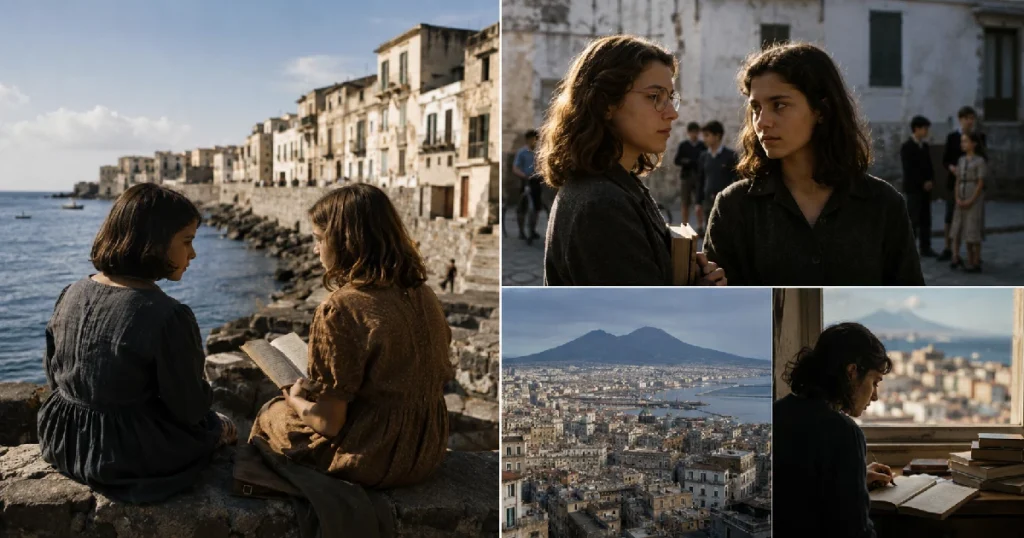
It’s difficult to ignore how accurately the Neapolitan Novels’ opening line about tasks taking on the urgency of passion captures the reading experience. After they begin using My Brilliant Friend, people usually stop using it for a while. Four novels, published between 2012 and 2015, written by a woman going by the name Elena Ferrante — a name nobody has ever definitively matched to a face. Curiosity would be sparked by that mystery alone. People stay there because of the writing.
The story follows Elena Greco, known as Lenù, narrating decades of her life and her friendship with Raffaella Cerullo, called Lila. It begins with two girls in a poor neighborhood outside Naples in the 1950s, both sharp, both hungry for something bigger than the streets they grew up on. They read all the time. They dream, somewhat unrealistically, of becoming rich writers one day. Their bond is genuine and also, unmistakably, competitive — the kind of friendship where love and rivalry sit right next to each other without canceling out.
What makes the books work isn’t really the plot, which unfolds slowly and without much traditional drama. It’s the texture. Ferrante builds Naples out of small physical details — cracked courtyards, dust, the noise of large families crammed into small apartments, the sound of men shouting in the street. She writes about poverty and sexism without turning either into a lecture, which is a harder trick than it sounds. Readers come away with something closer to a memory than a plot summary, dust and sweat and old classrooms lingering long after the page is turned.
Lila remains the more haunting figure of the two, and it’s tempting to think Ferrante knew that from the start. She’s brilliant, unpredictable, occasionally cruel, and her fate by the end of the series is left genuinely unresolved. Readers never learn exactly what happens to her — whether she disappeared, died, or simply chose to vanish from Elena’s life. Many people have been frustrated by that ambiguity. It’s also, arguably, the most honest choice Ferrante makes in four books that consistently refuse to offer comfort where comfort isn’t earned.
The television adaptation, produced in Italy with a largely Italian cast and crew, deserves some credit here too. It resisted the urge to sand down the story’s rougher edges. Much of the dialogue is in Neapolitan dialect rather than standard Italian, which apparently required subtitles even for native speakers. Margherita Mazzucco and Gaia Girace carry the middle seasons as teenage Elena and Lila, and the eventual handoff to older actresses in later seasons will likely feel jarring to viewers who grew attached to the earlier pair. That’s probably unavoidable when a story spans sixty years of a person’s life.
Then there’s the autobiography question, which seems to follow Ferrante everywhere. She’s given interviews to the Paris Review, the Guardian, Corriere della Sera, each time offering answers that are honest but slippery. She has said the emotional truth is real even when the specific events are invented. She’s also acknowledged that the friendship at the center of the books draws on someone she actually knew in childhood, someone who has since died. That detail changes how the books read, once you know it. It’s still unclear how much of Lila is invention and how much is memory dressed up as fiction, and Ferrante seems content to let that stay unresolved.
Whether the Neapolitan Novels count as autobiography or invention might be the wrong question anyway. What lingers isn’t the factual accuracy but the feeling that someone wrote down exactly what it was like to grow up poor, female, and ambitious in a place that expected none of those things from you. Investors in literary fiction — publishers, readers, critics — have been chasing that same feeling in Ferrante’s later work ever since, with mixed success. Some stories, it turns out, only get told once.
