A certain type of novel is not just read and appreciated; it becomes ingrained in society to the point where it appears in classrooms, courts, and eventually legislative discussions. Having written best-selling legal thrillers for decades, Scott Turow has given this more thought than most. It’s more of a reading list than a list of his favorite legal novels. It’s more akin to a debate about what fiction can accomplish that news reports and legal briefs cannot.
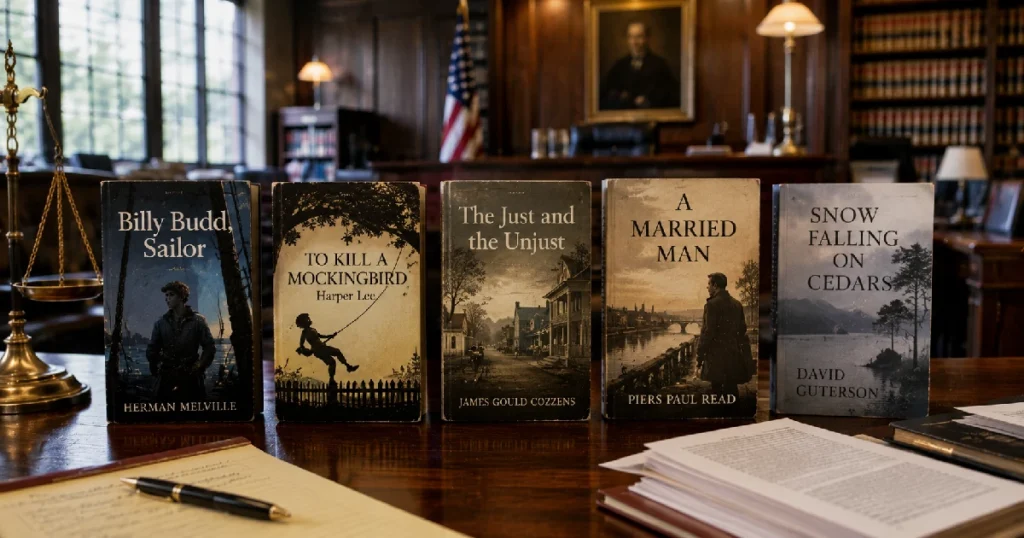
Surprisingly, he begins with Melville. Published posthumously in 1924, Billy Budd’s Sailor is a thin, nearly straightforward tale that takes place on a Royal Navy ship during the Napoleonic wars. It’s difficult to argue against Turow’s description of it as a classic examination of the divide between justice and the law. Billy Budd is put to death by Captain Vere, whose name, Turow notes, is derived from the Latin for truth, despite the fact that the provocation was clear and unfair. It is required by law. Vere’s conscience never gets better. The moral machinery of the story still functions flawlessly, though it’s possible that Melville failed to fully recognize the homoerotic subtext that scholars now interpret into Claggart’s harassment of Billy.
Next is To Kill a Mockingbird, which Turow doesn’t pretend has aged perfectly. He describes it as sentimental, somewhat outdated, and unquestionably lovely nonetheless. The real civic significance of the book is more difficult to ignore. Turow makes the somewhat persuasive argument that a book this well-known contributed to a shift in public opinion prior to the Civil Rights Act, with Atticus Finch serving as a sort of abbreviation for a version of legal virtue that the nation wished to think was achievable. He points out that Atticus is more admired by lawyers than by readers in general, partly because the character embodies an ideal that Watergate would later make nearly impossible to maintain with a straight face.
The Just and the Unjust, a 1942 book by James Gould Cozzens that Turow claims was the only book ever reviewed in the Harvard Law Review, is a true curveball. He brings it up because no one assigns it anymore. It’s a calm, unglamorous depiction of a small-town lawyer’s life in 1930s America; there are no car chases or unexpected turns, just a patient depiction of what the profession truly entailed a century ago. Cozzens was once mentioned with Hemingway and Faulkner. Turow’s explanation, which is refreshingly direct, explains why he isn’t anymore: Cozzens was just a very talented writer who redefined what American fiction could do while working in the shadow of two.
Turow primarily brings up Piers Paul Read’s 1979 novel A Married Man, which is about a London lawyer who is getting close to forty and has an affair. He seems to be genuinely bothered by the fact that it is currently out of circulation; he mentions it specifically in the hopes that it will be reissued. A smaller, more personal echo of the large symbolic conflicts Melville staged a century earlier, the book connects one man’s personal crisis to a larger sense of moral decline in the country.
The list concludes with David Guterson’s Snow Falling on Cedars, which addresses prejudice in general and anti-Asian sentiment in a small Washington town following World War II as seen through the lens of a murder trial. Turow describes it as excellent, pointing out that Guterson’s father practiced law, which is evident in the accuracy with which the courtroom scenes are portrayed. Strangely, the movie version failed to do the book justice, and Turow believes that this discrepancy gradually damaged the book’s reputation. Seeing how a mediocre movie can lessen the cultural impact of a truly great book is a small lesson in the real workings of legacy.
When combined, these five books don’t provide a neat explanation of how fiction alters the law. Instead, they present a picture of the law’s ongoing inability to adequately represent justice, spanning four centuries and multiple very different courtrooms.