
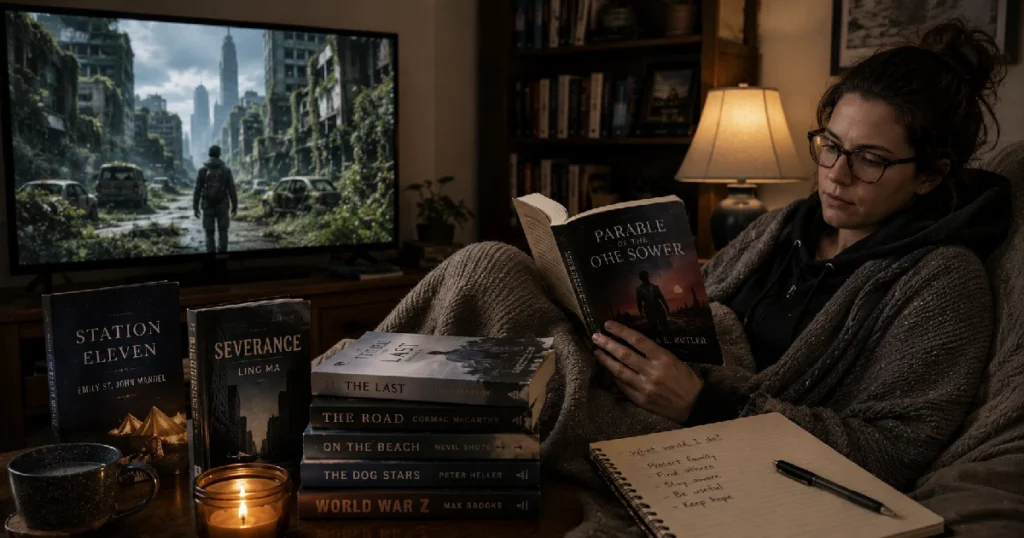
Some people find themselves staring at the ceiling at midnight, contemplating how they would survive a pandemic that wipes out 99 percent of the world. When written that way, it sounds insane. However, it appears that a huge number of viewers and readers do just this, drawn to stories about the end of the world every night. Publishers have taken notice. Streaming platforms have also done so. The demand for collapse narratives hasn’t decreased in years; on the contrary, it appears to be growing.
One reader follows a fairly familiar route as she descends into the genre. First up was Octavia Butler’s Parable of the Sower, a brilliant but genuinely unsettling read set in a climate-collapsed 2025 that felt uncannily similar to the news cycle. Then came Emily St. John Mandel’s Station Eleven, which alternates between the world before the pandemic and the twenty years after almost everyone on the planet dies from the flu. She became so engrossed in both books that she founded a book club centered around them, demonstrating the speed at which this genre of fiction can transition from curiosity to obsession.
The opposition that existed prior to the obsession taking hold is intriguing. For years, she had stayed away from zombie apocalypse content, only watching The Last of Us on HBO because her husband presented it as research. She anticipated that she would either detest it or put up with it. Rather, she was engrossed not only in the tension but also in the smaller human moments that were strewn throughout it: the ugliness, of course, but also the unexpected tenderness between characters who were trying to cling to something that resembled a life. The real hook appears to be that combination. Observing people improvise a meaning within it is more important than destruction for its own sake.
The reading list continued to expand after that. A more subdued and unfamiliar perspective was provided by Ling Ma’s Severance, a first-generation immigrant’s tale woven through a slow-motion collapse, with silence and weeds gradually reclaiming New York City in the first few weeks. Then Hanna Jameson’s novel The Last, which is set among stranded conference attendees in Switzerland following nuclear strikes on most major cities, is a mix of murder mystery and survival story. Collapse fiction turns out to be less of a genre than a whole testing ground for various theories about human nature, and it’s possible that variety is part of the appeal. Each book takes a different approach to the same fundamental idea.
In a piece published in the New York Times during the early stages of the pandemic, Agnes Callard posed an intriguing question: should people read apocalyptic novels while actually experiencing something apocalyptic? Surprisingly, she responded in the affirmative, arguing that intentionally seeking out challenging emotions is preferable to completely numbing out and that purposeful suffering can occasionally be healthier than emotional flatness. It’s a strong case, but not everyone agrees with it. In 2020, many found the opposite to be true, unable to bear a fictional collapse while experiencing a slower-moving real one.
Curiosity about oneself, rather than fear, appears to be what truly engages readers of this genre. What’s really left when social obligations, jobs, and bills are eliminated? Would people become violent, or would there be a more communal response, similar to the kind of unplanned assistance that Rebecca Solnit described in A Paradise Built in Hell during actual disasters? Fiction has a tendency to blur the lines, with brief moments of kindness tucked away in largely depressing depictions of how people behave under duress. Even though the readers who read these stories obviously want to believe in people, it’s difficult not to feel a little let down by how infrequently they do.
Additionally, something akin to rehearsal is taking place here—a private practice of envisioning one’s actual response. Who would I defend? Would I show courage or would I freeze? It’s practically impossible to provide an honest response to this question without the crisis actually happening, which may be the reason fiction—a low-stakes simulation of the highest possible stakes—continues to be sought after instead. It’s tempting to believe that the genre speaks less about impending catastrophe and more about a very common desire to comprehend what a person is made of once everything else is taken away after seeing this play out in so many novels and television series.
It is genuinely unclear and likely varies from reader to reader whether this appetite for collapse stories reflects real anxiety about the future or something more akin to psychological rehearsal. What is consistent, though, is that the fascination seldom results in despair. If anything, readers report feeling calmer rather than more terrified afterward—as though safely picturing the worst while lounging on a couch serves as its own peculiar kind of preparation.