
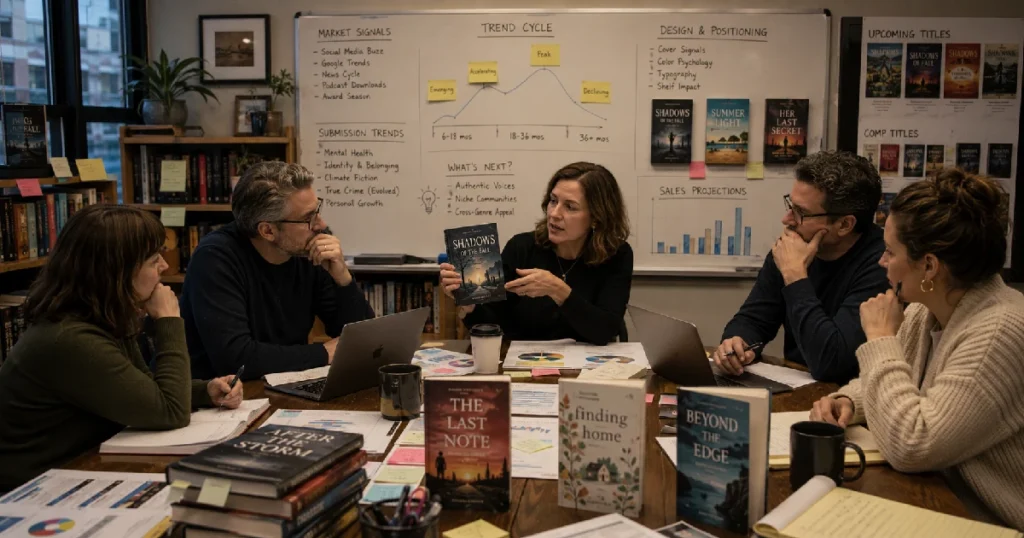
A common misconception among novice writers is that decisions about publication are based solely on the quality of the writing. It’s a reassuring notion, but it’s also largely incorrect. It’s true that editors and acquisitions teams read manuscripts, but they also read something much more difficult to describe: the spirit of a culture that hasn’t yet made up its mind. From the outside, this process looks more like reading tea leaves while a spreadsheet is open in a separate tab than grading an essay.
Raw numbers can mislead those who are not skilled at reading them because they flatten nuance. A genre with high sales this quarter might be actually picking up speed, or it might be dragging along on inertia, supported by readers who are more at ease than enthusiastic. Differentiating between those two states requires judgment, which no dashboard can adequately provide. Mistaking familiarity for momentum could be the secret reason why many publishing bets go wrong.
Cultural discourse typically comes before, not after, the books. Before appearing in manuscripts months or years later, themes like mental health, identity, and personal development didn’t start out on bookshelves. Instead, they developed gradually in social media threads, news coverage, and the entertainment people were already consuming on television and in podcasts. In a way, editors who listen to those upstream discussions are attempting to read the future through its earliest, faintest signals. Being on the shore and trying to guess which ripple will turn into a wave is a bit like this.
Surprisingly, submission piles provide one of the most reliable early warning systems in the business. The market is rarely exhausted when multiple unrelated manuscripts begin to revolve around the same theme during the same season. It typically indicates that something is changing beneath the surface, something that writers are observing on their own before anyone has fully expressed it. Finding the pattern isn’t the editorial skill here; it’s practically mechanical. It involves determining which variation of the pattern is genuinely enduring and which is merely noise disguised as a trend.
Additionally, most readers are unaware of how predictive design choices are. A bold, high-contrast thriller jacket conveys a different message to a perusing reader than a simple cover, and illustrated covers have infiltrated modern fiction in ways that would have seemed out of place ten years ago. These are not random aesthetic decisions. They are condensed signals designed to convey to a reader who is browsing what emotional experience they are about to purchase in roughly two seconds. Regardless of the content of the book, a mismatched cover, such as a literary one on a commercial thriller, can subtly ruin it.
Here, speed is crucial, and various publishing routes just travel at varying speeds. Since an author controls the entire process and can release a book in a matter of weeks, self-publishing can respond to a trend practically instantly. With its longer production schedule, traditional publishing is betting on where the wave will be in a year or two rather than where it is right now. The reason hybrid publishing has become more popular among writers who don’t want to take a chance on either extreme is likely because it attempts to balance the two: expert advice without the glacial timeline.
Many of these tasks have been improved by technology without truly taking the place of human labor. Although engagement analytics and keyword tracking tools can identify what’s popular this week, trends change more quickly than most software updates, and it still takes a skilled editor to distinguish between a true cultural shift and a two-week spike that has already faded by the time a book could be positioned around it. It appears that publishing technology investors think the tools will eventually bridge that gap. The gap hasn’t shrunk much so far.
The conflict between following a trend and maintaining what initially made a writer’s voice worth publishing is perhaps more significant and more difficult to categorize. The difference between a book that feels timely and one that feels like a photocopy is that good agencies often encourage authors to find a unique angle inside a popular space rather than copying what is already selling. This delicate balance is easy to make mistakes in either direction: if the book deviates too much from the trend, it will struggle to find readers; if it deviates too much, it will vanish into a pile of nearly identical titles that no one will remember by spring. Even so, getting it right still seems less like a formula and more like an educated guess made by people who have been wrong enough times to understand what is wrong.