A certain type of reader consumes State of the Union speeches, foreign newspapers, biographies, and political novels with the same appetite that most people save for prestige television, treating politics less like a pastime and more like a second job. That includes a novelist who, according to his own account, worked on his own political manuscript for eight years, five to eight hours a day, seven days a week. It’s an almost monastic dedication to a genre that most casual readers only occasionally dabble in. It also poses a genuinely intriguing question: why does fiction consistently return to the topics that politicians spend the majority of their careers refraining from publicly discussing?
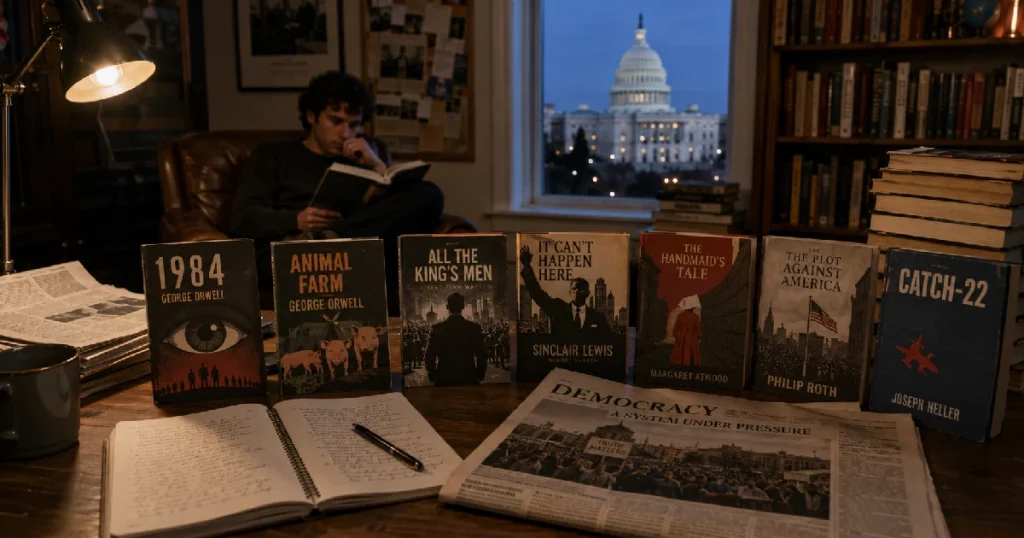
Permission appears to be a part of the solution. It is impossible for a senator to stand on the floor and give a detailed account of what it is like to witness a democracy turn into something else. A writer of novels can. This freedom served as the foundation for George Orwell’s entire body of work, and decades after they were published, Animal Farm and 1984 are still the first books that people consult because they gave words to issues that the politicians of Orwell’s day were either too cautious or too compromised to address. It is not necessary for fiction to seek reelection. It is precisely this lack of consequence that allows it to express the quiet part aloud.
Instead of cautioning about tyranny from the outside, Robert Penn Warren’s All the King’s Men takes a slightly different approach, tracking the internal deterioration of a populist politician. It’s more of an autopsy than a prophecy, a study of how good intentions turn ugly when power is involved. With It Can’t Happen, Sinclair Lewis took a more direct approach. Here, envisioning an authoritarian slide in America decades before such a scenario became more than just a thought experiment. When you read these books together, you’ll notice a pattern: the novels that survive don’t forecast a particular election result. They are the ones who capture a mechanism: how institutions are bent, how fear is turned into a weapon, and how common people justify doing things they know are wrong.
Over the past ten years, Margaret Atwood’s The Handmaid’s Tale has taken on an odd new life, appearing on magazine covers and at protests in ways that its author most likely didn’t fully envision when she wrote it. The secret to good political fiction is that it transcends the time period in which it was written. Readers who are experiencing some new form of the same anxiety keep rediscovering it, which speaks more to how repetitive human political behavior is than to the book’s original prescience. The Plot Against America by Philip Roth explores the same subject from a different perspective, envisioning a different past in which fascism gained more traction in the US than most people would like to think was feasible.
It’s more difficult to measure, but it’s difficult to ignore, how much these books serve as permission slips for readers as well, providing a vocabulary for feelings of unease that they may not have yet fully expressed to themselves. Fiction has the opportunity to examine moral ambiguity that a politician, constrained by electoral math and messaging discipline, just cannot afford to touch. An attack advertisement features a senator who acknowledges uncertainty. A novelist is deemed insightful if they create a protagonist who is morally compromised. This asymmetry may help to explain why so many readers turn to fiction when they are experiencing real political anxiety, looking for something that can sit with contradiction rather than turn it into a talking point.
The counterargument that political novels can be exercises in confirmation bias as much as illumination, providing readers who are already convinced with a more sophisticated version of what they already believed, should also be acknowledged. In certain situations, that is probably true. However, the best books on any serious political reading list tend to be difficult to align with one side or the other; for example, Catch-22 parodies institutional absurdity in a way that makes it difficult for anyone to read it as partisan propaganda. The last novels appear to be more concerned with human behavior under pressure and systems than with keeping scores.
The question of whether fiction truly affects political outcomes is still up for debate and most likely always will be. The fact that novels continue to do what politicians are structurally unable to do—sitting inside discomfort long enough to actually examine it rather than managing it for the next news cycle—seems less debatable. From Atwood’s dystopia to Roth’s alternate history to Orwell’s postwar anxieties, this genre has endured over a century of wildly disparate political moments. It is almost comforting to see how frequently readers turn to fiction when the news itself no longer seems relevant.
