
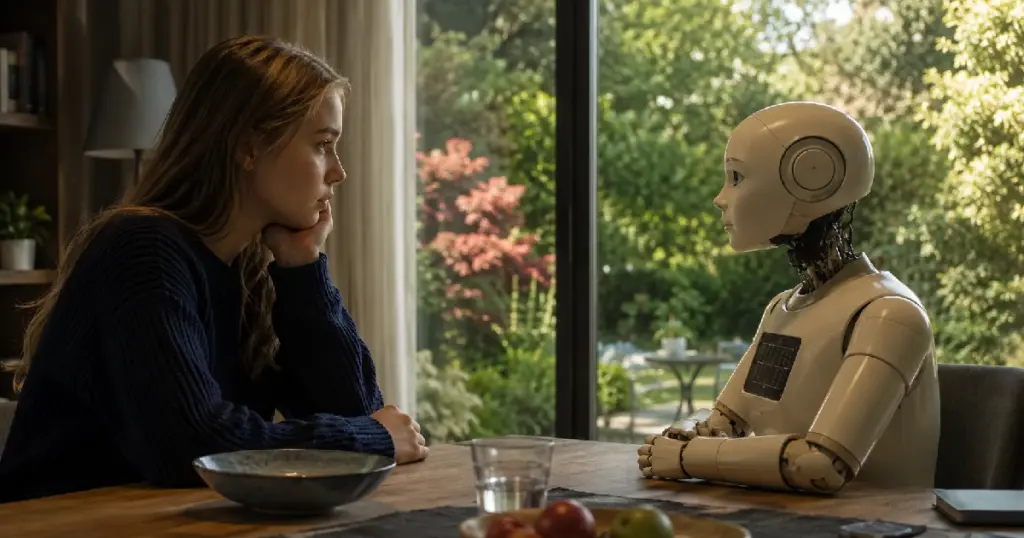
After a ten-year hiatus, Kazuo Ishiguro released his eighth book, and the literary community took notice in a manner that is reserved for authors who have truly earned that level of tolerance. On March 2, 2021, Klara and the Sun debuted, with a BBC arts program devoted solely to its author, Nobel Prize lectures being discreetly reexamined, and readers who had been waiting for ten years wondering if the wait would be worthwhile. Yes, it was.
On paper, the idea seems simple to reject. Klara is an AF, or Artificial Friend, a solar-powered robot that can be purchased in a store and is intended to help teenagers navigate whatever unclear form of puberty the near future may bring. She watches the street and follows the sun while she waits by a storefront window. She keeps getting passed over for more recent models. She is taken to a peaceful home outside of the city and given her purpose when she is ultimately selected by a girl named Josie. After reading the setup, you might assume that you already know this will be a cold, speculative, and cautionary book. None of those things describe it.
Over the course of forty years and eight novels, Ishiguro has developed a patience for what most literary writers ignore: the way common people carry love, grief, and guilt all entangled together without quite being able to distinguish between them. None of them are blatantly good or bad, including Rick’s mother Helen, Josie’s mother, and the portrait artist who comes to the house. One of the most subtly heartbreaking things Ishiguro has written is Helen’s emotional collapse as she begs a former lover to help her depressed son Rick get admission to a university that might transform his life. She is aware of her desires. She doesn’t even know why she desires it. The whole point is that ambiguity.
A careless writer might have completely lost the reader in the solar-worship section. Klara views the sun almost as a god; she literally depends on it because her batteries are solar, but her respect for it goes beyond that and verges on faith. It’s odd and shouldn’t function. It functions. Ishiguro stays just far enough away from Klara’s reasoning to allow the reader to see what she is unable to: that her relationship with the sun is a sort of innocent projection, the same impulse that drove people to construct temples in the direction of the sunrise thousands of years ago. Ishiguro seems to find this more poignant than frightening.
With remarkable accuracy and equally remarkable blindness, Klara describes everything she sees. She observes a street reunion between two strangers and notes that they appear both joyful and distressed, genuinely perplexed by the paradox. Naturally, the reader is not at all perplexed because we are fully aware of how that feels. The emotional weight of the book resides in that space between what Klara can see and what she cannot feel. Ishiguro gives it to you directly.
What forgiveness really costs is the question the book seems to be most interested in, though it never quite says so. Adults in this world are haunted; they make decisions in the dark, believing they are protecting their children, even though it is obvious that they are also protecting themselves. Josie’s mother had her daughter “lifted,” a genetic alteration that gives Josie an advantage in school but has left her chronically sick. It is purposefully left unclear whether the mother’s choice was motivated by love or something more akin to ambition. Rick was never lifted by Helen, and she carries that in a different way—a particular loneliness that she finds difficult to overcome.
It’s difficult to ignore how closely this relates to decisions parents make today in systems that already dictate a child’s future based on factors like wealth, school, and postcode. The distinction between “lifted” and “unlifted” is not nuanced science fiction. It’s a slightly exaggerated version of an existing event. In the 1930s, Aldous Huxley anticipated this. Ishiguro doesn’t yell about it because he can still see it coming. He simply shows you Rick, who is gifted, kind, and systematically underprivileged, and he believes you will be able to handle that on your own.
When the conclusion does come, it is neither a surprise nor a revelation. Compared to that, it is quieter. Josie gets better. Through Rick, she communicates to her mother that she loves her, forgives her, and would make the same decision again. Klara thinks she’s been healed by the sun. The reader may think something more nuanced. That’s the whole point of Ishiguro’s approach: let the characters come to basic conclusions, and you handle the more challenging ones.
Artificial intelligence may be the worst advancement in human civilization, according to Stephen Hawking. Ishiguro may or may not agree with that; Klara is one of the book’s friendliest and most devoted characters, and it would be hard to find her menacing. However, Klara isn’t the true threat that the book is focusing on. It’s humanity’s readiness to adapt, make sacrifices, and engineer their way out of uncertainty, as well as what they might unintentionally give up in the process. Not to technology. To themselves.
Forty years. Eight books. a Nobel Prize. Ishiguro has yet to write a careless sentence, and Klara and the Sun is evidence that restraint—when used with complete dedication—remains one of the most uncommon and effective literary fiction techniques.
