
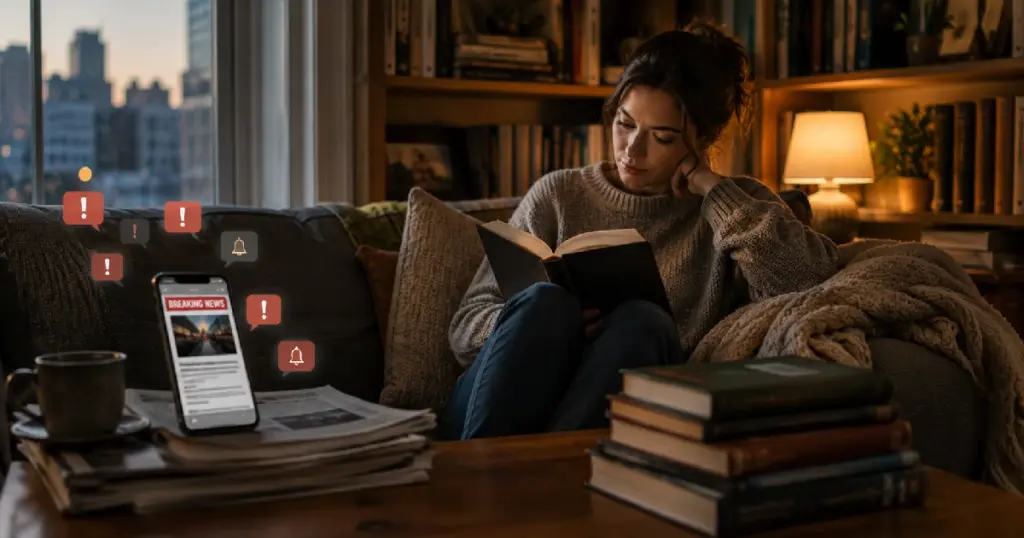
Something quietly broke between the morning’s third push notification and the week’s fourteenth cycle of outrage. Not in a big way. Not all at once. However, there is a sense that an increasing number of people no longer rely on the news to make sense of the world. This feeling is difficult to define but simple to identify. Instead, they start reading novels. And not because they’re uninformed or uninterested. In many cases, the opposite is true.
The figures have been mounting for some time. According to a 2020 study, only 14% of Americans’ daily media consumption consists of news. People increasingly see journalists as elites operating in their own interests, either politically biased, economically compromised, or just too cut off from everyday life to be of any use, according to research published in the Columbia Journalism Review. The way many people think in private was summed up by one study interviewee: “It’s all slanted.” He was described by another as “always skeptical.” These weren’t extreme opinions. These were recurrent themes among a wide range of adult Americans. There is a trust issue in journalism, and it is not going away.
This is not an issue in fiction. Not in the same manner. By its very nature, a novel declares itself to be invented, and for some reason, this honesty lends it greater credibility than a news article masquerading as objective reality. There is no algorithm that selects a story because it incites rage when a novelist writes about a character dealing with grief, poverty, or the particular loneliness of living in a city where no one knows your name. No one made it click-optimized. The author simply sat through the experience long enough to portray it truthfully. That deliberateness and slowness read differently than a headline designed to evoke an emotion in you right away so you’ll share it before you’ve given it any thought.
The structural state of the news is another issue. The 24-hour cycle favors the divisive over the subtle and the urgent over the significant. Unresolved stories are filed, updated in real time, and corrected in footnotes that most readers never see. The most popular emotions are anger and anxiety, not because journalists are bad people but rather because the platforms that disseminate journalism depend on user interaction, which reacts to danger. As a result, many people find the media environment to be more draining than educational. People who fact-checked news articles online were actually more likely to believe false information, not less, according to research published in Nature. Sometimes the resources meant to increase our knowledge actually make us worse. Being in such a situation is truly peculiar.
All of this is avoided in fiction. You are spending time with a character whose contradictions develop gradually, whose circumstances have context, and whose decisions reveal something about human motivation that a four-paragraph news brief can’t touch when you spend three weeks living inside a novel—a real novel, the kind that asks you to do something. Literary fiction and the growth of empathy—the ability to simulate other people’s inner lives and see the world from a different perspective—have been directly linked, according to research published in scholarly journals on the psychology of reading. In a media environment that has spent years teaching people to react rather than comprehend, that is a big deal.
Control may play a role in the inclination to pick up a book rather than a news app. While you’re reading it, the novel doesn’t change. The characters don’t alter their opinions in response to popular polling. A breaking alert about a horrible incident occurring somewhere else does not break up the story. Fiction has a quality of enclosure where you enter a world that has been planned, drafted, revised, and finished before you ever encountered it. This feels almost countercultural at the moment, when everything on the internet seems incomplete, provisional, and subject to sudden revision.
Naturally, the news’s deeper issue is that the majority of readers are aware that they are being monitored. People become more cynical and, ironically, more vulnerable when they become aware of the mechanisms of media manipulation, which were previously invisible but are now clearly visible. According to research published in the Columbia Journalism Review, people who mistrust journalism simply decide that everything needs to be independently verified rather than ceasing to consume it. Then, using the same hacked internet that generated the initial story, they do a poor job of verifying it. There is no clear way out of this loop.
In the journalistic sense, fiction does not promise truth. It promises something more akin to truth: truth about what it’s like to be human, truth about how ambition corrupts, truth about how grief endures, or truth about how kindness is misinterpreted as weakness. There is no way to verify those facts. Readers are surprisingly adept at discerning whether these observations are true or not. Most newsrooms are still finding it difficult to regain the trust that is created by that gut-level recognition, which is developed over hundreds of pages rather than delivered in a push notification.
Sitting with all of this, it’s difficult to ignore the fact that the novel was practicing journalism long before it became a recognized profession. Dickens wrote about poverty. Steinbeck recorded displacement. No wire report could match the specificity with which Zola documented labor conditions. The distinction between documentation and fiction has always been more hazy than we like to admit. Fiction has time, which everyday journalism frequently lacks. This allows a story to breathe, reveal the human element in the data, and withstand the pressure of the present. It seems to be the rarest thing in the information economy right now. And where it still exists, people are becoming aware of it.
