
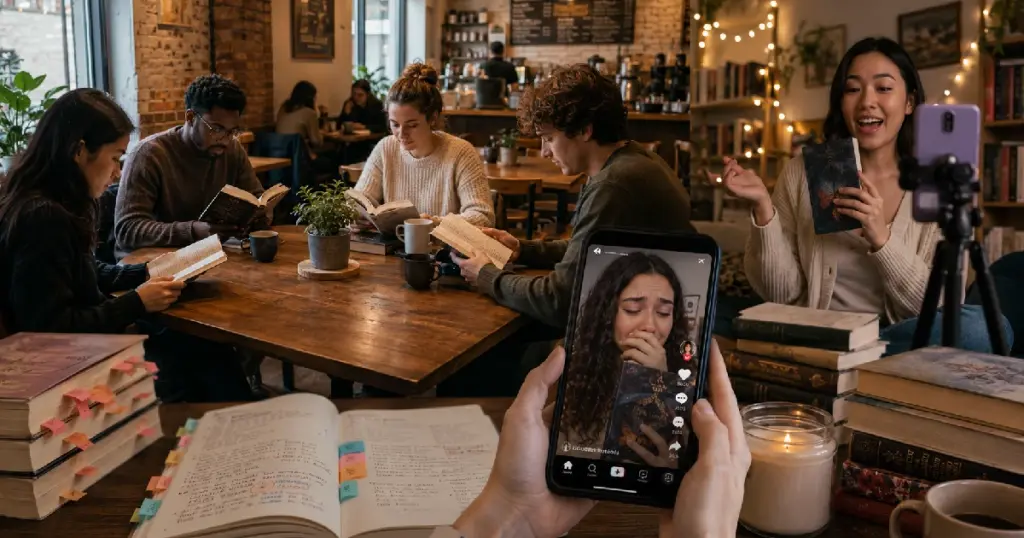
Imagine a Saturday morning in a coffee shop with handwritten menus and exposed brick. Four people sit at a corner table with their own books; they don’t talk, don’t share earbuds, and don’t look at their phones. Occasionally, one of them glances up, meets the gaze of another, and then looks back down. They are strangers who connected via an online post about a silent book club gathering. When the hour is up, they will discuss what they read. They are just spending time together alone for the time being, which turns out to be something that a surprisingly large number of people have been secretly desiring.
Depending on the reader and the time of day, reading has always had a slightly different meaning. The image was private for the majority of the 20th century: a person by themselves with a hardcover, shielded from the cacophony of everyday life. That image persists, but it’s been joined now by something noisier and more communal and, frankly, harder to look away from. BookTok, the loosely organized corner of TikTok where readers post about books with the kind of emotional intensity usually reserved for actual life events, has pulled reading out of the bedroom and into a public conversation that runs around the clock. Someone in Manila posts a thirty-second video saying a certain fantasy novel left them unable to function. After watching it at midnight, a person in Toronto purchases the book before the video concludes and shares their thoughts six days later. This was not organized by a publicist. No review publication commissioned it. It simply shifted.
What drives the contagion isn’t really the books themselves — or not only the books. It’s the sincerity. The creators who perform quiet devastation over a fictional character’s choices aren’t performing in the cynical sense; they mean it, and that comes through in a way that polished literary criticism rarely does. “I haven’t been the same since chapter twenty-one,” “this character owns my soul,” and “I need to be hospitalized” are examples of purposefully, almost proudly, exaggerated language. Clearly exaggerated. However, the underlying emotion—that a story entered your head and rearranged something—is genuine, and readers can instantly identify it because they have experienced it themselves and have seldom found a way to express it.
In addition to the poignant performances, a secondary vocabulary has emerged that merits consideration. Online book discovery is now organized according to tropes, which are the particular emotional promises a story makes. lovers’ adversaries. Burn slowly. discovered family. Love is forbidden. arc of revenge. These are emotional contracts rather than precise genre classifications. A reader who searches for “enemies to lovers slow burn fantasy” is not perusing; rather, they know exactly what they want and are searching for the most dependable source. Because they know that a well-placed trope combination can do more for early sales than a starred review in a trade publication, publishers have taken note and modified blurbs and taglines to speak this language. It’s an odd cycle: the vocabulary was developed by readers, amplified by the algorithm, and now sold back to the original creators by the industry.
All of this has been criticized, and it is not wholly incorrect. Books that go viral on the internet raise expectations that no book was intended to meet, and it can be quite disappointing when the reading experience doesn’t live up to the hype. There’s also the more subdued worry that reading could turn into a show rather than an experience—the person who records their unboxing and annotated pages but doesn’t seem to care as much about what the book actually says. On these platforms, trend cycles happen quickly, and regardless of a title’s true quality, it can completely disappear from the conversation by the next month after dominating it for three weeks. It’s still unclear if the attention economy benefits literature in the long run or if it merely speeds up a churn that wears out serious readers a little.
However, there is a real counterbalance to all of that. With just one video uploaded by the appropriate account, debut authors who would have remained unknown for years under the previous model have found their audience. Someone who learned about out-of-print novels secondhand and couldn’t stop talking about them has brought them back into the conversation. Because something on their feed made fiction feel urgent and relevant rather than obligatory, readers who hadn’t picked up a book in years have returned. It’s difficult to become completely skeptical of this after seeing it develop over a number of years. The reach is too real, and the sincerity is too constant.
BookTok teardowns, Goodreads reading challenges, and silent book clubs all point to the same fundamental change: reading has evolved into something people want to do in comparison to other people. Not in place of solitude—reading still necessitates it—but in addition to it. The book remains a private entrance. What has changed is the number of people who are now waiting on the other side to discuss their findings.
