
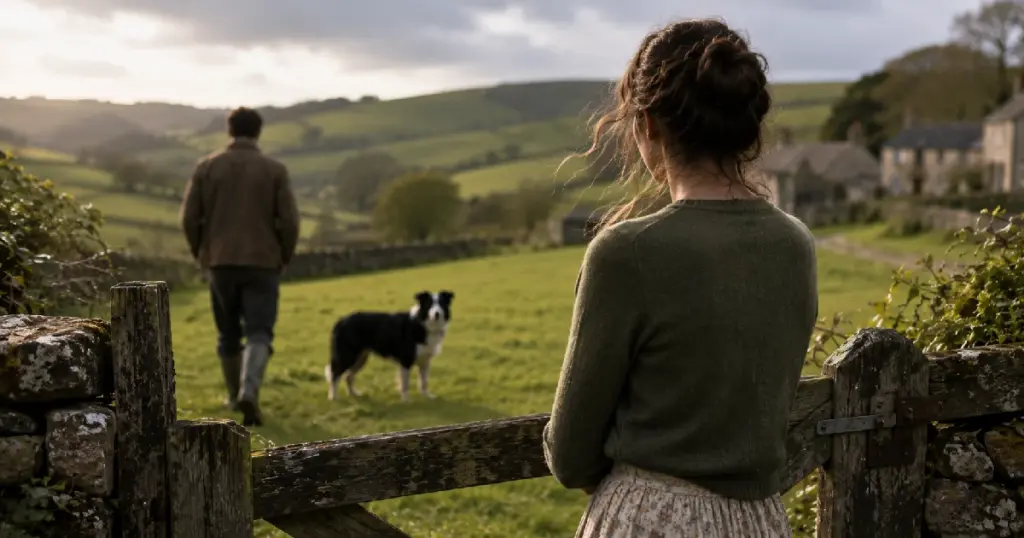
There’s a particular kind of novel that sneaks up on you. You think you know what it is — a country love story, maybe, pastoral and a little melancholy — and then somewhere around the midpoint, you realize the floor has quietly dropped out from under you. Clare Leslie Hall’s novel is exactly that kind of book. It arrives softly, carrying the smell of Dorset fields and muddy farm boots, and then it doesn’t let go.
Beth and Frank Blakely are, by most measures, a couple who have already survived their worst thing. Two years before the story begins, their nine-year-old son Bobby died on the farm. Frank had promised to watch him that afternoon. He didn’t. That guilt — the kind that hollows out a man slowly, from the inside — sits at the center of their marriage like a stone in a stream, redirecting everything around it. Beth has forgiven Frank, or at least she tells herself she has. Her grief is different. It’s quieter, more total. She feels Bobby’s absence every single day, in the particular way only a mother can.
Then a dog without a lead crosses onto their property and kills three young lambs, and everything changes. The dog’s owner is Gabriel Wolfe — a successful writer, handsome in that particular way of men who know the world has treated them well, and also Beth’s first love. The one she chose not to marry. The one she has never entirely stopped thinking about. And Gabriel has a son with him. The boy is the same age Bobby would have been.
It’s possible that Hall designed that detail too deliberately — the almost-uncanny mirroring of ages — but it doesn’t read that way. It reads like life, which has a tendency to deliver its cruelest ironies with a completely straight face. Beth begins spending time with the boy while Gabriel writes. Something in those hours with him feels restorative. She calls it feeling “unbroken,” and you believe her entirely.
The novel operates on three timelines simultaneously, which sounds more complicated than it feels in practice. There’s 1955, when Beth and Gabriel first fell in love — young, consuming, the kind of love that marks you. There’s 1968, the story’s present, with Gabriel’s unexpected reappearance. And running alongside both is a courtroom thread, a trial narrative in which the reader gradually understands that someone has been murdered, though Hall withholds the who and the why with admirable patience. That last thread is what transforms the book from a character study into something with real narrative tension. It keeps you reading even when you’re not sure you can bear more of what’s coming.
What’s remarkable is that the love triangle at the novel’s core doesn’t make Beth seem weak or duplicitous, even though by any objective measure her situation is morally complicated. Hall gives us enough of 1955 — enough of what Gabriel and Beth were to each other — that you understand why her feelings never fully resolved. And Frank, the husband, is drawn with such genuine decency that you find yourself wanting things to work out for him even while rooting for the people who are making his life more difficult. That’s not easy to pull off. Most novels ask you to pick a side early. This one refuses to let you.
The writing itself is assured and precise in a way that feels lived-in. Hall’s Dorset is physical and real — the back-breaking rhythm of farm labor, the particular silence of fields after dark, the way shared work can hold a marriage together even when everything else is fraying. Watching Beth move through that landscape, carrying grief and desire and guilt in equal measure, you feel how fully Hall understands what it means to be a person trying to do right by everyone and failing, inevitably, in small and large ways at once.
The trial narrative eventually delivers its revelations, and they land with the quiet force of a well-set charge — not explosive exactly, but powerful enough that you need to sit with it afterward. The quote Hall uses almost as a thesis — about secrets being harbored and chewed over until they splinter lives with needlepoint precision — turns out to be a fair description of what the novel itself does to the reader. It’s not a comfortable book. But it is, in the end, a generous one.
