
Most of us have at least once told a certain type of literary lie. At a dinner party, someone brings up James Joyce. Rather than saying, “I started Ulysses twice and quit both times,” you might nod slowly, whisper something about stream-of-consciousness, and let the moment pass. No one confronts you. Since it’s unlikely that anyone else in the room has read it.
This is the peculiar, somewhat embarrassing world of writers whose names have great cultural significance, whose books are displayed on shelves like awards, and whose actual pages are mostly unread. It’s a phenomenon that reveals more about how literature permeates public life—often without anyone opening the cover—than it does about the authors themselves.
A classic is something that everyone wants to have read but no one wants to read, according to Mark Twain, who had a gift for cutting through pretension. He stated this more than a century ago, and nothing has changed since then. If anything, social media aesthetics, “[currentlyreading” posts, and the unique social currency of owning the right books have stretched the gap between literary reputation and actual readership.
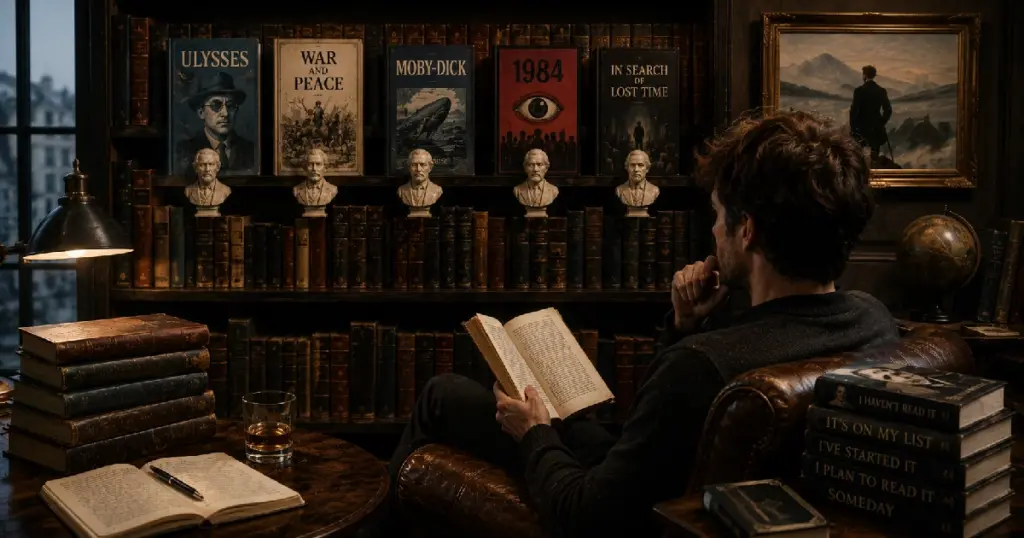
War and Peace by Leo Tolstoy is arguably the most obvious example. When people wish to convey seriousness, they use this novel. Someone says, “It’s not exactly War and Peace,” which means it’s not that difficult, lengthy, or demanding. However, how many of those who use that phrase have actually read all 1,200 pages of Tolstoy’s expansive, brilliant, and frustrating masterpiece? To be honest, there aren’t many. The majority of readers who try it reach the long passages on military strategy somewhere in the middle and covertly place the book face down on a nightstand, where it remains.
Though for different reasons, Moby-Dick by Herman Melville meets a similar end. The opening line, “Call me Ishmael,” is well-known, and most readers get through the first few chapters because they are engrossed in the mood and the fixation. The general public stops reading after Melville spends forty pages describing the exact anatomy of a sperm whale. It’s possible that more people own Moby-Dick than have ever finished it, which is an odd way to honor a book regarded as the best in American literature.
James Joyce is practically unique in his category. Not only is Ulysses unread, but it is renowned and legendarily unread in a way that has come to define its character. The novel’s difficulty is almost seen as evidence of its excellence. The fact that Joyce’s last book, Finnegans Wake, was written in a language that hardly resembles English hasn’t done much to damage his reputation or increase the number of people who actually read it. He is adored by academia. He is respected by the general public. Outside of graduate seminars, very few people have actually read him from beginning to end.
The mechanism underlying this pattern is what makes it intriguing. It is sometimes referred to as “cultural osmosis” by academics who study reading behavior. Without ever interacting directly with the source, you take in the meaning, themes, famous lines, and cultural allusions. The most notable contemporary example is probably George Orwell’s 1984. The book has evolved into a sort of political acronym. People describe it as “Very Orwellian” or “straight out of 1984,” and they are typically correct. However, a startling proportion of those individuals came into contact with Big Brother through cultural discourse rather than Orwell’s actual writing, which is icy and incisive and deserving of reading on its own terms rather than merely as a point of reference.
Marcel Proust lives in a quiet, ridiculous corner of the world. Some of the most remarkable writing about memory, desire, and time in any language can be found in his seven-volume In Search of Lost Time, which is approximately 4,000 pages long. A certain type of reader has persevered through it all; they are serious, patient, and truly committed to the project. They often use quiet, almost evangelical language when discussing the experience. For everyone else, Proust is something you’ve “started” or “been meaning to get to,” which is a kind of tribute in and of itself.
There is a certain irony in all of this that is difficult to ignore. Readers used to take these authors very seriously, to the point where they would sit with difficulty, reread passages, and write in the margins, all of which contributed to their fame. These days, reading is hardly necessary to maintain their notoriety. They have turned into cultural landmarks, which is both a sign of respect and a sign of desertion.
Some of the writers themselves appeared to be aware that this could occur. The French novelist Julien Gracq, who declined the Prix Goncourt in 1951 and avoided literary celebrity for decades, seems to have favored a smaller, more devoted readership over the kind of widespread, superficial fame that turns books into symbols. He lived out his final years in a remote area of rural France, mostly unnoticed by the daily passersby. That refusal to become furniture has an almost dignified quality.
The shorter work typically serves as an honest introduction to any of these authors. Dubliners, a collection of stories by Joyce, has the emotional depth and accuracy of Ulysses without the structural tricks. It takes about an hour to read Melville’s bizarre and contemporary novel Bartleby, the Scrivener. Finding the door that is genuinely open instead of standing outside the locked one and telling people you’ve been inside is what it means to start there, not settling for less.
Even the slow, challenging kind of authentic reading has merit. Not as a show. not to speak at gatherings. However, the writers who are most difficult to read are frequently the ones who have the most peculiar things to say—things that are essentially only found on paper and don’t translate well into summaries or cultural shorthand. For this exact reason, even those who have never quite reached that point continue to commend them.