
Take any great book off the shelf, whether it’s the kind assigned in school, the kind with a faded spine and someone else’s annotations in the margins, and you’ll find the same thing somewhere in the middle, beneath the famous lines, the period detail, and the plot. someone who is incapable of communicating. An unreachable individual standing in a crowded room.
Perhaps this is the oldest topic in literature. It’s not love, war, or death, but rather the unique pain of coexisting with other people without truly feeling a connection to them. The odd thing is that this is hardly ever given a direct name. After finishing The Great Gatsby, readers discuss the green light, the parties, and the glitz of the Jazz Age, but somewhere along the line, they lose sight of the fact that Gatsby hosts those gatherings because he is pathologically alone. Not a single person who frequents his mansion on weekends, consumes his food and alcohol, and spreads false rumors about him truly knows him. Wearing pricey clothing, he floats through his own house like a ghost, searching for a woman who stands for everything he is unable to access.
Fitzgerald captured a sense of loneliness in America that is still relevant today. the act of using plenty to hide emptiness. The hunger Gatsby experiences and that specific mix of longing and self-delusion are recognizable in ways unrelated to the 1920s, which is why the book has never truly dated.
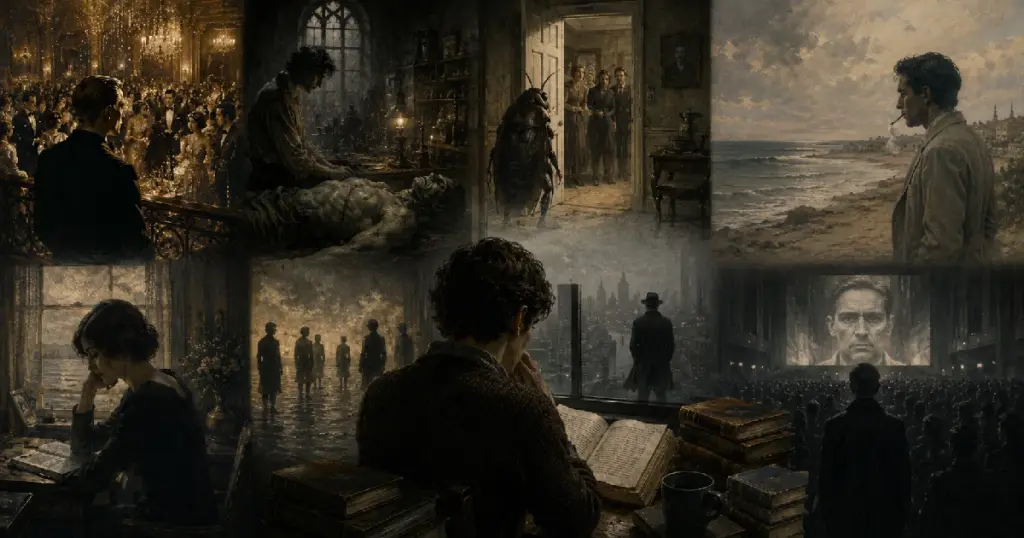
Mary Shelley was dealing with a more literal and rawer form of isolation. Not only is the Creature in Frankenstein metaphorically alone, but all living things, including the man who created him, physically reject him. The Creature’s lack of desire is what makes sitting with Shelley’s portrait so uncomfortable. He wants someone who doesn’t flinch when they see him, something that most people take for granted. At the age of nineteen, Shelley was living in a foreign country and had already lost a child when she wrote the book. Somewhere in those pages, you can’t help but feel that specific grief that shapes the Creature’s voice from the inside out.
Kafka became even more introspective. One of the most well-known scenes in literature is when Gregor Samsa awakens as an insect in The Metamorphosis. However, the horror lies not in the transformation per se, but rather in the way it reveals what was already true. Long before he turned into a bug, Gregor had been subtly invisible within his own family. He was tolerated rather than loved, worked to support them, and moved around the apartment like furniture. The insect is simply the ultimate manifestation of his expendability. The alienation in that novella lands differently depending on where you are in life when you read it, and Kafka had a talent for literalizing emotions that most people only vaguely sense.
Albert Camus approached the same subject in a more philosophical manner. Unlike the other characters on this list, Meursault in The Stranger hardly ever feels lonely. There is a gap between him and everyone around him as a result of his disengagement from social ritual, grief, and expectation. Camus appears to be questioning whether this gap is Meursault’s or society’s issue. Meursault’s apathy, which at times reads like emptiness and at other times like the only sincere reaction to a world that performs emotions it doesn’t fully feel, makes the book unsettling in a way that is difficult to shake.
From somewhere inside, Virginia Woolf wrote about loneliness. One of her most avant-garde and challenging works, The Waves, features six characters who deliver internal monologues throughout their lives that hardly ever connect with one another. They converse but fail to establish a connection. They don’t land, but they love. “I am very weary, though tears no longer flow” is a line from the book that expresses the unique weight of someone who has used up all the comfort that comes with crying. The texture of Woolf’s sentences and the way loneliness in her writing feels more like a climate than an emotion reflect the years she spent living with a mind that turned against her.
In Nineteen Eighty-Four, George Orwell, writing in a completely different register, put it most succinctly: maybe one wanted to be understood rather than loved. It’s a tiny, easily overlooked sentence in a book known for its political outlook. However, it may be the most accurate statement about loneliness found in the canon of English literature. It’s not the loneliness of being alone; rather, it’s the loneliness of constantly being misinterpreted and interpreted incorrectly.
The notion that reading teaches you about your own suffering is not new; James Baldwin discussed this aspect of books in an interview decades ago. That someone, somewhere, wrote in a different language, in a different century, and under completely different conditions, experienced exactly what you are experiencing right now. Something about that is subtly amazing. All these books, all this loneliness, all these unreachable characters—somehow, reading them is a kind of connection in and of itself. Ironically, the least lonely things you can hold in your hands are the books that most accurately capture isolation.