
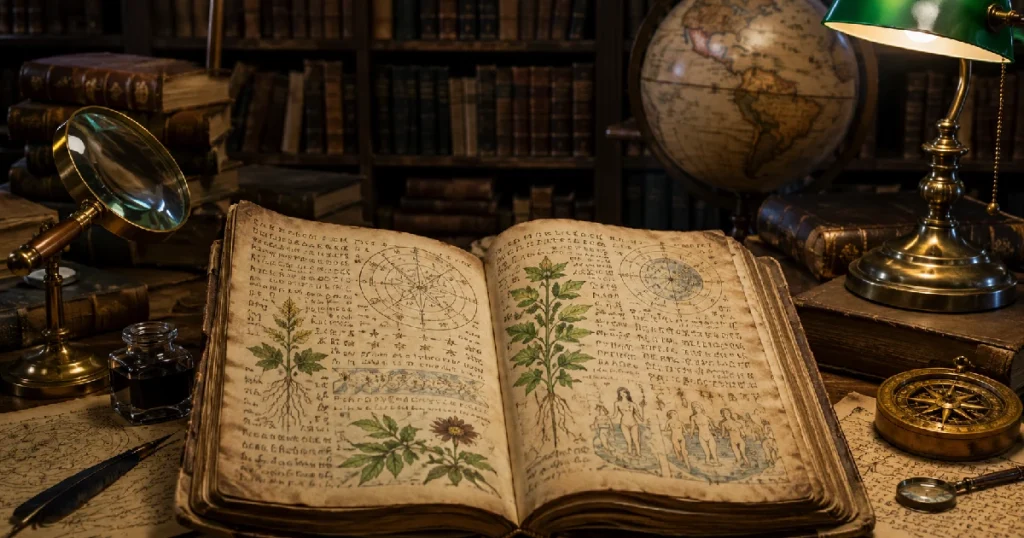
No one, living or dead, has ever successfully read a book that is kept in a climate-controlled vault at Yale University. It has withstood every computational algorithm thrown at it, outlived empires, and vanquished the greatest code-breakers of two world wars. Nevertheless, the army of people committed to finding a solution continues to expand.
The Voynich Manuscript is a roughly 234-page book written in a script that is unique to the world and is named for Wilfrid Voynich, the eccentric Polish bookseller who discovered it in 1912. Its pages are replete with astronomical diagrams, zodiac charts, naked figures bathing in intricate devices that resemble water slides, and botanical drawings of nonexistent plants. The text is arranged into what appear to be paragraphs with what appear to be capital letters, flowing beautifully from left to right. It’s not a madman’s sloppy handwriting. It reads—or rather, it appears—as though the author knew exactly what they were doing.
That’s why it’s so frustrating.
Wilfrid Voynich was anything but a spectator. Born in Lithuania, he was imprisoned in Siberia for engaging in revolutionary activities. He managed to flee through Manchuria and eventually arrived in London, where he established himself as one of Europe’s most esteemed rare-book dealers. On a shopping trip to a “ancient castle in southern Europe” (later revealed to be a villa outside of Rome), he came across the manuscript and instantly recognized it as something exceptional. He spent the remainder of his career attempting to prove that it was the work of the 13th-century friar Roger Bacon because he was so certain. That theory was eventually refuted by carbon dating. However, the manuscript had already taken on a life of its own by that point, and Voynich had left.
The ownership of the book can be traced back hundreds of years, but each transfer poses more questions than it provides answers. The item is said to have cost 600 ducats, or nearly ninety thousand dollars in modern currency, to Rudolf II, the Holy Roman Emperor and ardent collector of dwarfs, giants, and occult curiosities. Jacobus Hořč� de Tepenec, a pharmacist and snake-oil baron, followed him. It was said that he had healed the emperor from an unidentified serious illness. Georg Baresch, an alchemist from Prague, then tried for twenty years to crack it. The most well-known scholar of his day, a Jesuit polymath named Athanasius Kircher, who had falsely claimed to be able to decipher Egyptian hieroglyphics, received sample pages from Baresch in a kind of desperation that is heartwarming and a little humorous. Kircher was also unsuccessful. He wasn’t the final one.
William Romaine Newbold and the husband-and-wife team of William and Elizebeth Friedman, who had previously violated Japan’s Purple Code during World War II, are credited with the two most significant contemporary attempts. Convinced that tiny squiggles in the ink represented a hidden micrographic shorthand, Newbold spent the final years of his life and vision studying the manuscript under a magnifying glass. He was mistaken; the squiggles were simply the normal behavior of dried, cracked ink. Near the end of the war, the Friedmans formed a study group and worked on the issue for almost forty years before William came to the conclusion that the manuscript was probably an early attempt at a constructed language in a note that was sealed in an envelope and left with a journal editor. He was unable to substantiate it. He simply ran out of time.
The fact that the world’s greatest cryptologist, the man who assisted in the creation of the NSA, was forced to conceal his theory in an anagram because he was unable to come up with a better solution is particularly cruel.
Academic interest alone is not what sustains this. Amateur art historians, retired locksmiths, theoretical physicists, disabled veterans, and carpenters make up the entire online community that is devoted to the manuscript. They are like an invisible army of the curious, exchanging theories all day long on message boards and email lists. Men over fifty appear to make up the majority. Some people use strange codes to communicate. Because everyone is made equally humble by the manuscript, no one is judged. The man who wrote The Name of the Rose, a novel about a library where books conspire against their readers, was drawn to the one text that has never yielded to a single one when Umberto Eco visited Yale in 2013 and requested to see just one item from the Beinecke’s collection.
The statistical characteristics of the manuscript make it challenging to support the hoax theory. Letters and words are distributed in ways that are consistent with natural language, including characteristics that linguists weren’t even aware of until the 1930s. Certain words only appear in specific sections, such as those that are close to astronomical diagrams or plant illustrations. This topical organization is exactly what you would expect from a text that has real meaning. That could not have been faked by a medieval forger. Long before radiocarbon dating was even an idea, a forger in the 20th century would have needed six hundred years of blank vellum. Whether the text encodes an invented language, a real language, or something else entirely is still unknown. However, it is most likely not nothing.
However, there is an odd possibility that the solution to the manuscript may turn out to be disappointing. In a way, the book’s greatest accomplishment is its resistance to being read. If left uninterpreted, it could be a centuries-old joke, a lost language, or the secret world of a visionary. Those possibilities merge into one as soon as someone gets the hang of it. It turns into just another book, and books always come to an end, as readers are aware.
Despite this, the invisible army continues because that is what invisible armies do. They continue to appear, argue over the subtleties of parchment preparation, gallows characters, and pedestalled glyphs, and delve into Jesuit archives, medieval pharmacopeias, and trade routes. Some of them have worked in this field for thirty years. They’re not exactly doing it for attention. They are acting in accordance with the manuscript’s request, but thus far, no one has been satisfied.
For a book that no one can read, that is amazing.
