
Most households have a number of monthly expenses that they no longer give much thought to. A free trial of a streaming service that was never canceled. An audiobook subscription that made sense at the time. A language app running quietly at $13 a month, used enthusiastically for about three weeks and then forgotten. None of these costs feel large individually. That’s the point. But added up across a year, the average American household spends somewhere between $800 and $1,400 on media subscriptions, online learning tools, and similar digital content — a number that tends to surprise people when it’s laid out plainly.
The library card in most people’s wallets, the one with a slightly bent corner and a barcode that’s never been scanned, covers a meaningful portion of that. Free. There is no trial period. No automatic renewal.
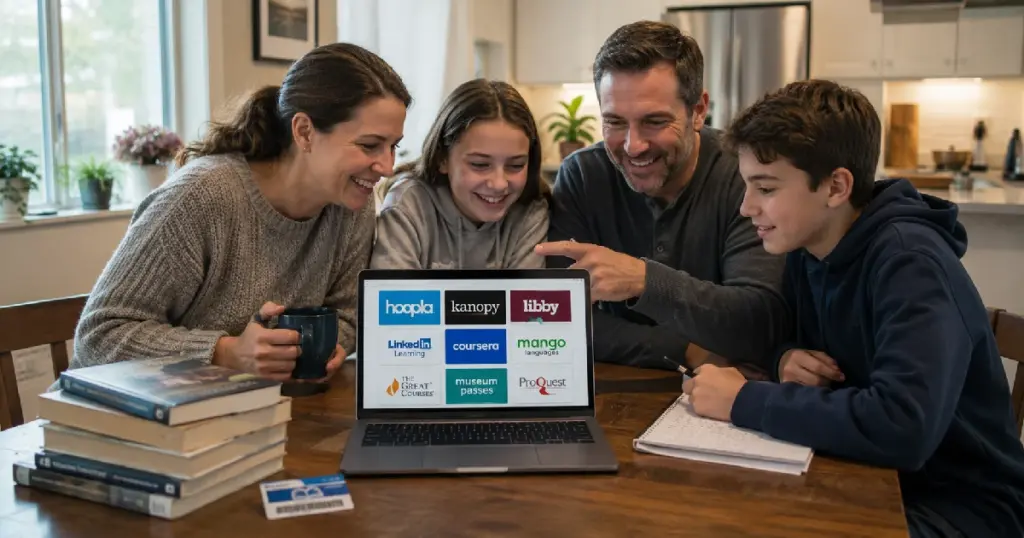
Since most people still think of libraries in terms of books, let’s start there. The math is already noteworthy. A modest estimate for a reading household is that a family of four would spend between $600 and $700 annually on books alone if they only purchase two new hardcovers each month. You can borrow those same books for free. When you include audiobooks, which cost roughly $165 a year for a basic plan on Audible, the figure continues to rise. The majority of large library systems provide audiobooks via apps like Libby or Hoopla, both of which are free with a card. Libraries have long had digital borrowing platforms. That one change, switching from an audiobook subscription to a library app, pays for itself practically right away.
The museum pass benefit is the one that tends to elicit the most genuine disbelief, so it merits special consideration for a family. In order to provide cardholders with free or reduced admission, many library systems collaborate with nearby museums, science centers, aquariums, and historic sites. A family of four could easily spend $200 to $350 on admission if they visit two or three of these establishments annually, each of which charges $20 to $30 per adult and $15 per child. That is eliminated by the pass. When you include the free streaming services that many libraries offer, such as documentary channels, movie archives, and educational materials, a family of four who make good use of their library system could actually save between $1,500 and $2,000 annually, if not more. That number isn’t exaggerated. It’s just the math itself.
Calculus is different but just as important for a college student. The main one is access to academic databases. Students who study remotely or at institutions with short library hours frequently have to pay for journal access out of pocket or forego it entirely, which has a cumulative negative impact on the caliber of their work. That issue is completely eliminated with a library card that grants access to databases like ProQuest or EBSCOhost, which can cost individual subscribers hundreds of dollars a year. Layer in online learning tools like LinkedIn Learning, which runs about $40 a month if purchased directly, and a student using their library’s digital offerings could be avoiding $500 or more in annual costs while also actually getting better research materials.
The working professional scenario may be the least obvious, which may account for its underutilization. Someone between jobs or shifting careers often needs professional development materials — courses, certifications, industry publications — and they need them at the moment when their income is most uncertain. Libraries offering platforms like Coursera for Libraries or similar tools give that person access to career-building content without the subscription cost arriving at precisely the wrong time. It’s a small thing, practically speaking. However, when the profit margin is narrow, little things count. A Valley Cottage Library card can help residents save money through free borrowing, digital content, educational tools, and special community resources — and Valley Cottage is not exceptional in this regard. It’s representative of what a functioning public library system now provides.
The fact that this math is rarely discussed has a subtle peculiarity. The internet is full of personal financial advice, with people arguing over whether to cook fresh or prepare meals, whether to stop Netflix, and whether a gym membership is worthwhile. Despite being the most economical choice available, the library card hardly ever comes up in that discussion. It’s difficult to ignore the gap. A portion of this is likely due to the perception issue that comes with free things: people believe they are getting what they pay for, so a free card must have limited value. If you don’t check what’s actually available, that assumption ends up being rather costly.
Thus, the practical recommendation is straightforward. Spend twenty minutes on the library’s resource page (not the homepage, but the digital resources section) to see what has already been covered before renewing the next subscription that has been on autopay for six months. There is no cost associated with the card. The cost of the trip to find out what it includes is roughly the same.
