
One type of writer can make you forget that you are reading. That was precisely the type of writer Alexandre Dumas was: unrelenting, dramatic, a little overwhelming, and somehow always correct about human nature. Alongside his heavier-hitting works, his 1850 novel La Tulipe Noire, also known as The Black Tulip in English, doesn’t always receive the recognition it merits. That seems like a subtle injustice. Because one of the most emotionally honest stories Dumas ever wrote is about a Dutch horticulturist, a jealous neighbor, and a flower valued at 100,000 francs.
The lynching of Johan de Witt and his brother Cornelis in 1672, when a mob turned against them and dragged them through the streets of The Hague, is one of the darkest moments in Dutch political history. Here, Dumas wasn’t just writing fiction. He was weaving a tale of common obsession—the kind that persuades a man to devote his entire life to the cultivation of a single ideal flower—with actual historical horror. Dumas had a profound understanding of the conflict between public tragedy and personal desire, likely due to the fact that his own life was rarely straightforward or peaceful.
The protagonist of the book, Cornelius Van Baerle, is a wealthy and kind man whose true crime is that he grows tulips too well. Isaac Boxtel, his neighbor, observes from the other side of the wall with a kind of hatred that is uncannily familiar; it’s not exactly rage, but rather the slow deterioration of envy that transforms a decent person into something more repulsive. The machinery of injustice moves swiftly when Boxtel reports Van Baerle to the authorities, citing his association with the disgraced De Witt brothers as justification. Van Baerle is sent to prison. Despite everything, his tulip bulbs follow him.
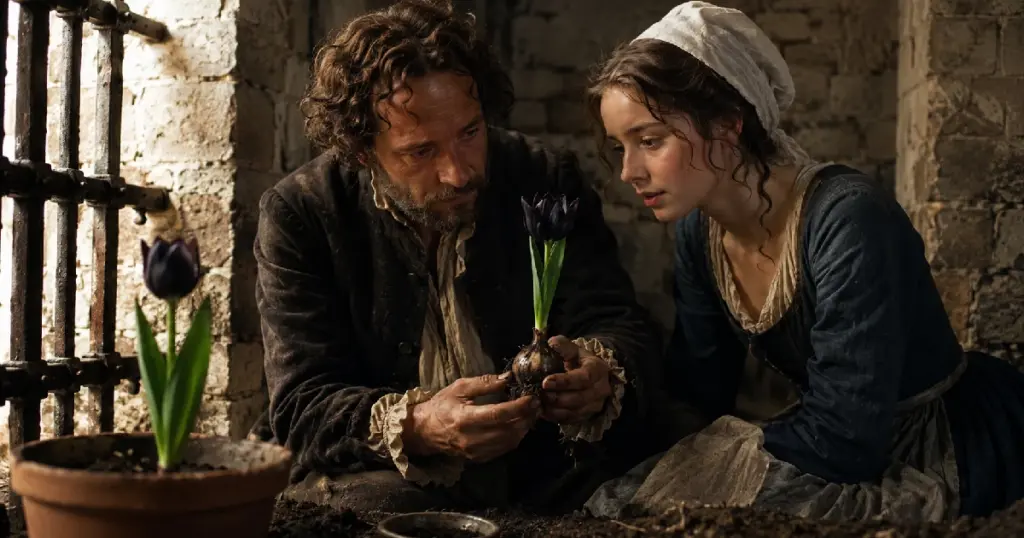
It’s important to take a moment to recognize the structural work that Dumas was doing. Van Baerle could have become a political figure, a rebel, and a man of great causes if he had done so. Rather, he turned him into a gardener. Someone whose greatest goal was to create a flower that no one had ever seen. Focusing a historical novel on a man whose greatest passion is botany has a subtly radical quality. And there’s a feeling that Dumas truly appreciated that kind of devotion—the kind that exists inside something almost spiritual, outside of ambition and profit.
Dumas’ most dependable creative collaborator, Auguste Maquet, co-wrote the book, and their partnership is noteworthy. Maquet made a substantial plotting and research contribution to a number of Dumas’s major works, which raised authorship issues that literary historians continue to debate. The way the book reads is probably unaffected by whether Dumas was the main architect or a very talented editor of Maquet’s frameworks. There is consistency in the voice. The emotional reasoning is sound.
One of those supporting characters who subtly keeps the whole narrative together is Rosa Gryphus, the jailer’s daughter who assists Van Baerle in caring for the tulip bulb inside the prison walls. She is said to be courageous and moral, qualities that would make her unworthy in less capable hands. However, Dumas gives her enough presence and agency that she becomes truly essential to the novel’s philosophy as well as the plot. Without Rosa, the book might just be a tale of injustice. With her, it turns into a tale about what makes people human when everything is taken away from them.
A prize of 100,000 francs had been offered by the city of Haarlem to the person who could cultivate a true black tulip. Until you sit with them for a while, the stakes seem almost comical. fame, wealth, and immortality through naming rights. The tulip would always bear the winner’s name. The significance of that prize had completely changed for Van Baerle, a man decaying in a cell. Money was no longer a factor. It was about proving something to Rosa, to himself, and to the Providence he kept calling upon.
When the book was released, Dumas was 48 years old, already well-known beyond most authors’ wildest dreams, and the author of The Three Musketeers and The Count of Monte Cristo. La Tulipe Noire and those two novels are similar in that they both deal with wrongful incarceration, enduring patience, and ultimate vindication. It’s difficult to ignore the fact that Dumas frequently used this specific narrative form. There is no clear answer to the question of whether that speaks to his personal fears or just what he found dramatically satisfying.
When reading La Tulipe Noire today, it is evident that Alexandre Dumas was writing about something more enduring than Dutch politics in the 17th century. He was writing about how easily institutions can ruin people, how jealousy can masquerade as morality, and how someone in a terrible situation can still decide to create something lovely. “Sometimes one has suffered so much that he has the right never to be able to say, ‘I am too happy'” is the quote that concludes the novel’s emotional arc. It carries the weight of a statement written by someone who had thought about suffering seriously but had not actually experienced it.

Chloe Olliver is senior editor at vclib.org, where she leads editorial coverage of literary criticism, political commentary, cultural analysis, and the evolving relationship between literature and public life across New York City and beyond. With a career spanning the intersection of literary journalism, political commentary, and educational publishing, Chloe brings both rigorous research discipline, in-depth knowledge, experience, and an accessible editorial voice to subjects that most readers find thought-provoking and culturally significant.