
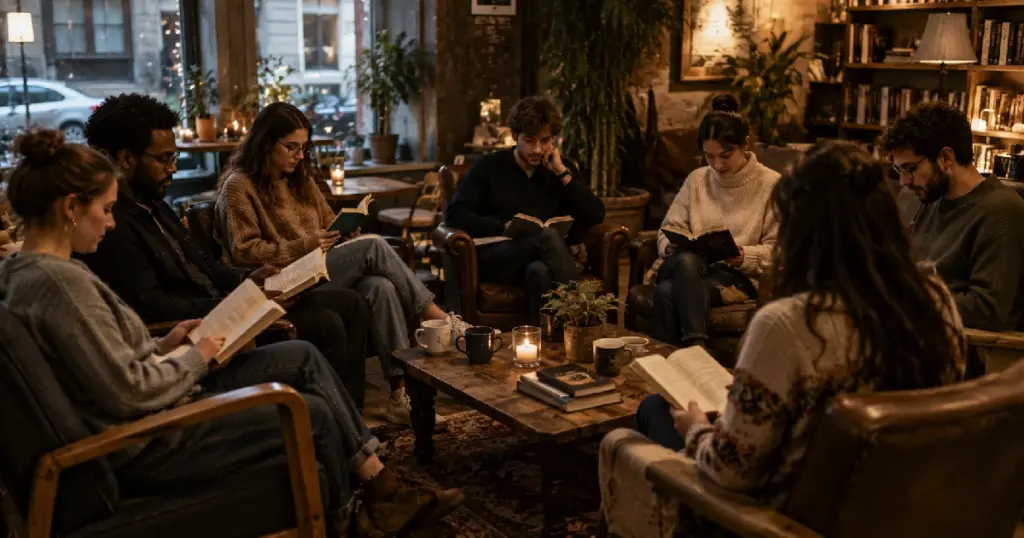
There’s a good chance that if you walk into a café on a weeknight in practically any city right now, you’ll find a table full of strangers sitting in complete silence, each hunched over a different paperback, with no one talking for a good forty-five minutes. That scene would have seemed odd ten years ago. For the Silent Book Club members, it’s only a Tuesday now, which is one of the more obvious indications that people’s preferences for group reading have changed.
Of course, book clubs never truly disappeared. It’s likely that your aunt’s neighborhood group has been getting together every month since the Clinton administration, working its way through whatever Reese Witherspoon chose that quarter, wine glasses steadily being refilled as the actual book discussion veers toward gossip after thirty minutes. To be honest, that version is still in use today. However, it’s becoming less and less the dominant version, and it’s no longer the only one.
Who is joining and why has changed. In a recent piece for The Conversation, psychologist Joanna Pozzulo of Carleton University observed that younger adults’ interest has been steadily increasing, with significant proportions of Gen Z and Millennials now claiming to be members. For a hobby that has spent the better part of two decades witnessing a decline in reading-for-pleasure rates as phones consumed an increasing amount of people’s attention, that is a noteworthy reversal.
Perhaps the explanation is easier to understand than anyone would like to acknowledge. People are worn out. Weary of scrolling, weary of notifications asking them to do something, weary of virtual friendships that never quite materialize into something you can sit across a table from. Nearly the opposite is what book clubs provide: a set time and location, an excuse to put down your phone and simply hang out with others. Sociologists used to refer to this as a “third space,” a place that isn’t home or work, and for a long time, those spaces were subtly vanishing. Strangely, some of that gap is being filled again by book clubs.
This moment is intriguing rather than merely nostalgic because the format keeps breaking. The performative analysis is completely removed in silent book clubs; you just show up, read, and, if you’d like, speak a little. No one questions you about themes or symbolism. The number of niche clubs centered around horror, queer fiction, fantasy, or BIPOC-centered storytelling has also increased, indicating that people are seeking company that reflects a particular aspect of their identities rather than just company in general. As this develops, it’s difficult to ignore how much more intentional these groups seem in comparison to the somewhat coincidental neighborhood clubs of the past.
A lot of this is also powered by an engine that resembles TikTok. With users filming their reactions to plot twists and recommending books to followers they’ve never met, #BookTok transformed reading into something obviously social, almost performative in a positive way. There’s a tendency for that enthusiasm to spread offline. Three weeks later, a book that becomes popular on a fifteen-second video clip frequently becomes the September selection for a club meeting in someone’s real living room. This is an example of how the digital and analog are feeding each other, which isn’t always the case.
All of this does not imply that book clubs have developed into an unstoppable cultural force, and it is still unclear how much of the current fervor will endure once the novelty wears off for the platforms that support it. Once the next trend emerges, social media virality-related trends tend to fade. However, the underlying desire for leisurely conversation, an excuse to leave the apartment, and a shared story to discuss with others seems more timeless and resilient than any one app cycle. It was never really about the book by itself when we read together. It’s about having a place to take what you’ve discovered.
