
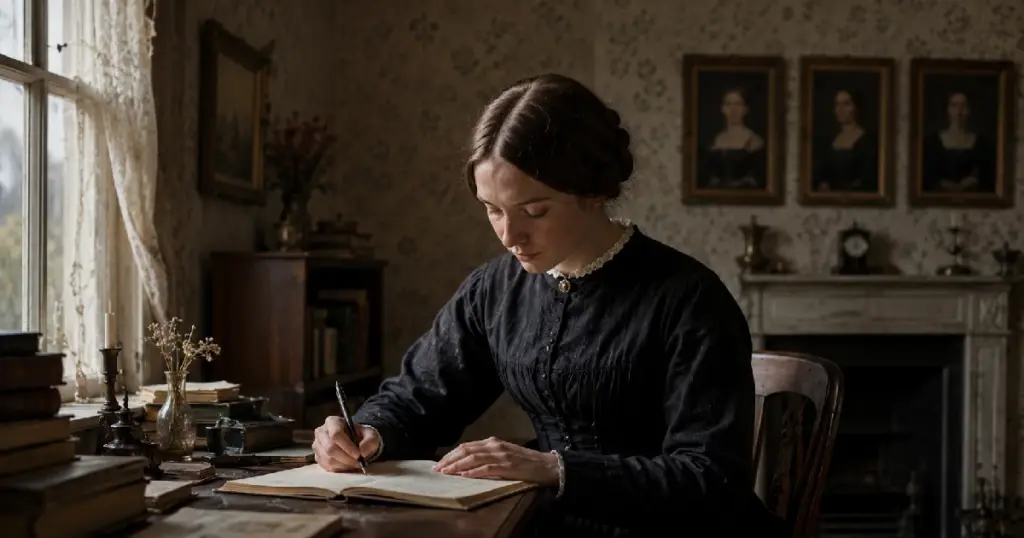
There’s something quietly stubborn about Anne Brontë. Her two novels don’t roar the way Wuthering Heights does, and they don’t carry the propulsive romantic energy of Jane Eyre. They observe. They document. They refuse to look away. Because of this, she was largely written off as the least talented of the three sisters by Victorian critics, who were primarily men. The more you look at her work, the more it seems like a case of intentional misreading. It’s a judgment that has never quite sat right.
Like her sisters Charlotte and Emily, who published as Currer Bell and Ellis Bell, respectively, Anne Brontë made the practical choice to publish both of her novels under the male pseudonym Acton Bell. The disguise was essential. In 1847, women writers were accepted in some registers, such as moral instruction and domestic sentiment, but Anne’s territory was far harsher. Her first book, Agnes Grey, is largely based on the years she spent as a governess in Yorkshire homes. The portrait is not attractive. The loneliness is numbing, the kids are wild, and the families she portrays are careless. The restraint with which she writes a scene in which she witnesses her young charges torturing small animals is nearly unsettling. She is not a big editorialist. She simply displays what she witnessed.
Agnes Grey is undervalued because it is used as a warm-up act for its more well-known successor. The governess, that archetypal character in Victorian fiction, is being transformed into a real person with real frustrations by the novel. This is a deliberate and specific action. The main character is neither tragic nor glamorous. It’s actually more difficult to portray her as exhausted, underappreciated, and quietly determined than either madness or passion.
Published only a year later in 1848, The Tenant of Wildfell Hall is a completely different kind of book. It announces itself through structure — an epistolary framing device, diaries within diaries — but the architecture is almost secondary to what’s happening inside it. Helen Graham shows up as a mystery at Wildfell Hall, a dilapidated estate. The neighbors gossip. The narrator, a farmer named Gilbert Markham, is drawn to her despite himself. Additionally, the novel completely changes when she gives him her personal journals, becoming more akin to a psychological depiction of a failing marriage.
The specificity with which Anne Brontë portrays Helen’s husband Arthur Huntingdon is noteworthy and, for 1848, truly shocking. He is charming and utterly self-centered, the kind of man who ruins everyone around him out of a total refusal to mature rather than out of malice. His drinking steadily gets worse. He hosts house parties where his adultery is practically visible. Seemingly driven by a desire to feel in control of something, he corrupts his own young son. Reading him, it’s possible to feel something like clinical recognition — the patterns of behavior that researchers and memoirists today associate with coercive control are all there, mapped out in 1848, by a woman in her late twenties who had likely seen similar dynamics up close.
Huntingdon is believed to have been inspired in part by Anne’s brother Branwell, who battled severe alcoholism and opium addiction and passed away the year the book was released. Whether or not that’s entirely true, there’s a specificity to the portrait that suggests direct observation rather than invention. Anne wasn’t theorizing about ruin. She had seen it.
When it was first published, the book was criticized for being allegedly coarse. After Anne passed away at the age of twenty-nine, Charlotte Brontë, acting as her literary executor, refused to permit a second edition. This decision has plagued Brontë scholarship ever since. While the original text was more difficult to locate, heavily altered versions circulated for decades. One of the more subdued acts of repression in literary history, it explains why Anne’s reputation lagged behind her sisters’ for so long.
The Tenant of Wildfell Hall has some valid complaints: it’s a lengthy book, some parts seem repetitive, and Gilbert is a romantic hero that’s a little hard to cheer for. He’s petulant and possessive, and his eventual apology to someone he physically injures is inadequate at best. Helen, for all her genuine moral courage, has a pious rigidity that can occasionally try the reader’s patience. However, these flaws add texture to the book rather than diminishing it. It was not fantasy that Anne Brontë was writing. She was writing about the consequences, solutions, and expenses faced by women who had unsuccessful marriages.
It’s easy to ignore the more subdued character of Eliza Millward, the vicar’s daughter who cheerfully and viciously spreads rumors about Helen, but she’s proof of a comedic talent that isn’t frequently attributed to Anne. She moves through the novel puncturing pomposity and spreading small havoc, and the scenes where she taunts Gilbert are genuinely funny in a way that feels out of step with the book’s reputation for severity.
Whether Anne Brontë would have continued to work toward something even more ambitious if she had lived past the age of twenty-nine is still up for debate. What she left behind suggests a writer who was just hitting her stride — precise, unsentimental, more interested in the texture of ordinary suffering than in the gothic extremes her sisters favored. Whether that constitutes genius, as the 1946 film Devotion implied it didn’t, probably depends on what you think genius looks like. Novels by Anne Brontë are quiet. But they have not stopped being heard.
