
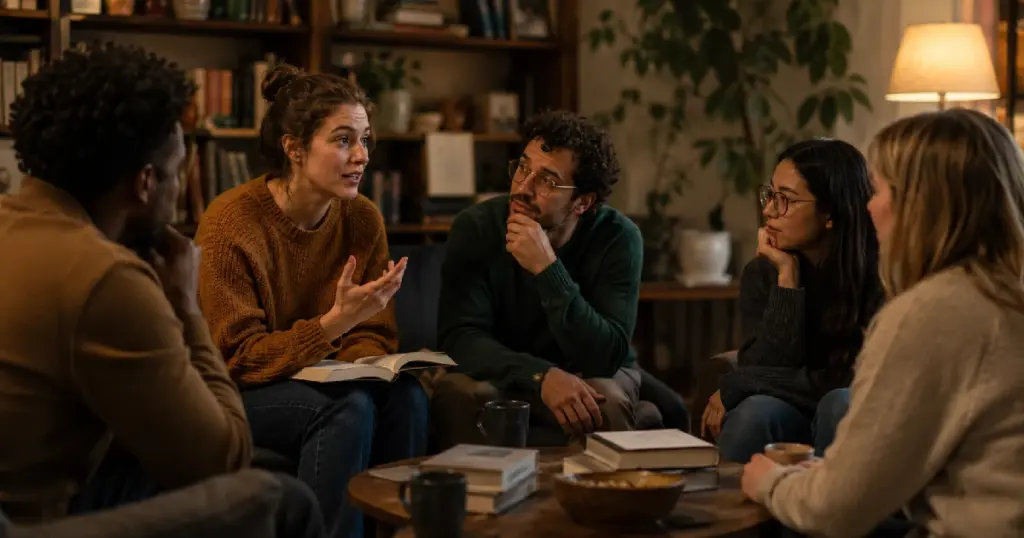
There’s something that happens in book clubs that nobody quite prepares you for. Someone insists that Anna Karenina’s final choice was inevitable, almost an act of grace. Someone else goes pale and says that’s the most disturbing interpretation they’ve ever heard. And suddenly the conversation has stopped being about a Russian novel written a century and a half ago and has become something far more uncomfortable — a conversation about each of them.
When you consider it, this is one of the strangest things that fiction can do to us. We walk into a story knowing it isn’t real, and we walk out changed in ways we can’t always name. The debate that ensues—about whether a character was correct, whether a villain was sympathetic, and whether an ending was justified—turns out to be more about who we are beneath the positions we’ve silently held for years than it is about the book itself.
The simple explanation is that we are being manipulated by storytellers. Novelists strategically withhold information, playwrights set up entrances and exits so grief arrives on schedule, and film composers swell the music. A sceptic would say that if you cried at a particular scene, all that proves is that the writer did their job. which, to a certain extent, is reasonable. However, it doesn’t explain why two people who are watching the same movie in the same theater leave feeling entirely different—one is devastated, and the other is oddly relieved.
Literary fiction, according to University of Toronto professor and novelist Keith Oatley, is a kind of long-term study of the human condition. Oatley has devoted much of his career to thinking about this. According to his research and subsequent studies, readers of fiction exhibit quantifiably higher levels of empathy than readers of nonfiction. Not only does fiction foster empathy, but it also explains why. You’re not just watching a character when you follow their inner life through hundreds of pages. You are engaging in the cognitive process of adopting another person’s viewpoint. For most of us, this might be the closest we ever get to actually trying on a different life.
When unexpected emotions are evoked by the fiction, it becomes truly illuminating. Sometimes a scene meant to be humorous ends up being depressing and melancholic. Sometimes a villain’s reasoning, which is meant to be disregarded, subtly makes sense. Sometimes a minor character in a throwaway chapter stays with you for weeks, long after the central story has faded. These asymmetries — between what the writer intended and what you actually felt — are harder to explain away as narrative manipulation. They point somewhere else. Inward, mostly.
A researcher at the University of Toronto found that people who regularly read fiction require what psychologists call less cognitive closure — meaning they’re more comfortable sitting with ambiguity, more willing to hold contradictory ideas without forcing resolution. Anyone who engages in serious book debates will be able to relate to that. There is hardly ever a consensus at the end of the discussion. It usually results in a sort of constructive ambiguity, a sense that the question was more intriguing than any possible response. It turns out that the point is that discomfort.
Additionally, there is the issue of memory. Immersion in a novel increases neural activity in ways that persist after the book is finished, according to studies on the effects of prolonged reading on brain connectivity. This phenomenon is sometimes compared to muscle memory, but the muscle being worked is imagination. It’s difficult to ignore the fact that those who read fiction the most frequently are also the ones who argue about it the most. This isn’t because reading is a result of passionate debate, but rather because reading sharpens one’s perception, which affects how one interacts with nearly everything.
Although less obvious, the social benefit is noteworthy. On screen, bookworms are perceived as socially awkward, excessively inward-looking, and a little out of place. The information presents a different picture. Instead of having less social skills, fiction readers typically have more. Reading about how characters resolve conflicts, misinterpret one another, and miscalculate their own motivations seems to translate into a marginally improved real-world calibration. It’s still unclear if that’s a correlation or a cause, but it’s a finding that defies stereotypes.
The payoff’s personal nature, however, is still unexpected. One viewer may find a Korean drama amusing, while another may experience true grief. A novel that reads as a morality tale to one reader lands as a tragedy about inevitable systems to another. The fiction is the same; the people encountering it are not. And when they argue about it — really argue, sitting with the discomfort, pushing back, revising — they’re doing something that goes beyond literary criticism. They’re finding out what they actually believe, which is rarely as stable or coherent as most of us would like to think.
That’s the real payoff. Not the storyline. Not even the empathy, exactly. It’s the self-knowledge that fiction forces on you when you’re not paying attention, disguised as something that just made you cry on a Tuesday night.
