
There’s a cartoon by Sam Gross in The New Yorker — a cat furiously clawing at an upholstered chair while the owner explains to guests: “We believe that in a former life she was an editor.” It’s funny because it’s specific. It turns out that excellent editors are particularly fixated on specificity.
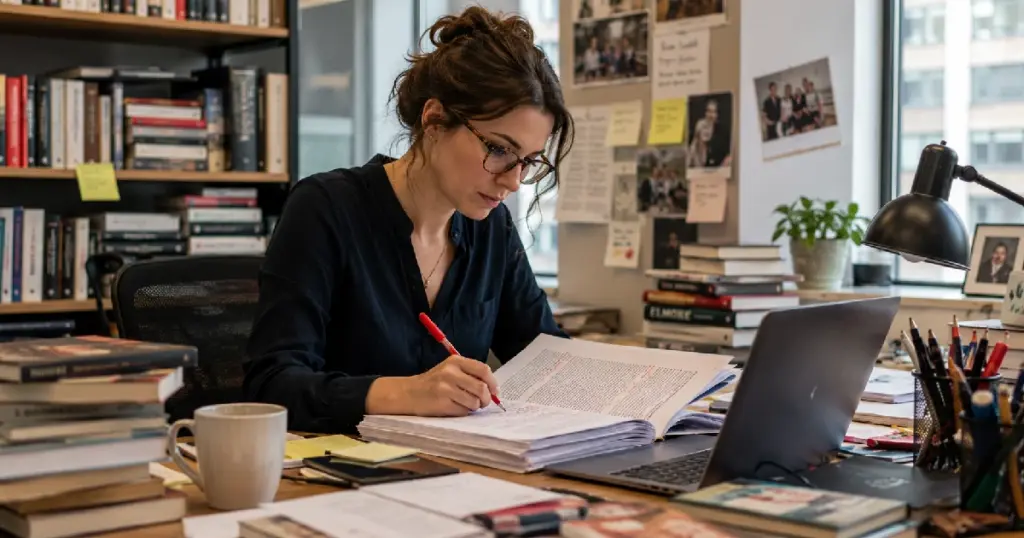
When most people think of a book editor, they most likely picture someone in a calm office with a fountain pen in hand, circling passive verbs and debating semicolons. In some ways, the reality is more intriguing and far less romantic. A typical Tuesday for a mid-level acquiring editor at a major publishing house might begin with forty emails before the coffee is cold, detour through three back-to-back meetings, and end with a manuscript open on a laptop during the commute home. The red pen is genuine. But it’s maybe ten percent of the job.
Walk into a publishing office on any given morning and the first thing that hits you is the sheer velocity of communication. One editor described fielding queries from the digital team about an author’s website listing, then pivoting to a conversation about galley copies being sent to reviewers, then moderating an internal panel discussion, all before 10 a.m. On an average day, she receives around a hundred emails. Not newsletters. Not spam. Actual decisions and questions requiring actual answers. It’s something like running a small project management firm, except the deliverable is literature.
The meetings are their own universe. Cover meetings, production meetings, imprint discussions, acquisition meetings — each one pulling a different thread of the same long, slow process of turning a manuscript into a book. The acquisition meeting, where editors advocate for manuscripts they’ve fallen for and try to convince a room of colleagues to spend real money on an unproven author, tends to be the most charged. There’s an almost intimate quality to it; you’re defending a narrative you support against the perfectly legitimate criticisms of those who hold different opinions. Publishing editors talk about these moments the way lawyers talk about closing arguments.
Most writers are unaware of the complexity of what actually occurs when an editor opens a manuscript; it takes place in several stages. Developmental editing comes first — the high-altitude view. Does the storyline make sense? Are the characters doing anything meaningful? Is the argument genuinely landing in nonfiction? At this point, an editor may advise a writer that the book actually starts on chapter two or that three of the flashbacks should be removed. It sounds brutal. Editors often portray it as compassionate. Observing the dialogue between an editor and a first-time novelist, it is more akin to guided excavation—discovering what the book is truly attempting to be—than critique.
Line editing is something else entirely. This is where an editor moves sentence by sentence, not to impose their own voice but to coax out the author’s best one. A skilled line editor, and there aren’t as many as publishing houses would like you to think, can take a paragraph that almost works and make it sing without the author quite knowing what changed. Making the entire manuscript read as well as the best parts already do is the aim, according to a seasoned editor. This may be the aspect of editing that most closely resembles art.
Grammar, typos, inconsistencies, and a character whose sweater changes color between scenes are examples of copy editing at a different register. It’s highly skilled work, but it’s procedural in a way that developmental editing isn’t. Although they both have an obsessive attention to detail that probably makes family dinners interesting, copy editors and acquiring editors are not the same.
Then there are the submissions. At Harlequin, for instance, the editorial team has at any given time over nineteen hundred pitches, proposals, and full manuscripts in various stages of consideration. A few are being read. Some are waiting for feedback from a wider team. Some are sitting in an inbox, waiting. The industry runs on a kind of structured patience that most people outside of it would find maddening. Agents wait for editors. Authors wait for agents. Everyone is waiting for someone. The emails keep coming regardless.
It’s difficult to ignore how much of the work is hidden from readers. The back cover text you skim in a bookstore? An editor wrote that. The cover direction that made you pick up the book in the first place? An editor briefed the art department on that. When a novelist worries about how chapter fourteen will end at midnight? There’s probably an editor somewhere on the other end of that email, talking them down and meaning every encouraging word. A new hire at a major house was once told that publishing is slow, until it isn’t.
It seems to be that one moment—reading a submission that stops them cold, like a piece of music sometimes does—that keeps editors in it despite the volume, pace, and waiting. locating the manuscript. That’s what the job description doesn’t mention, but it’s probably the whole point.
