
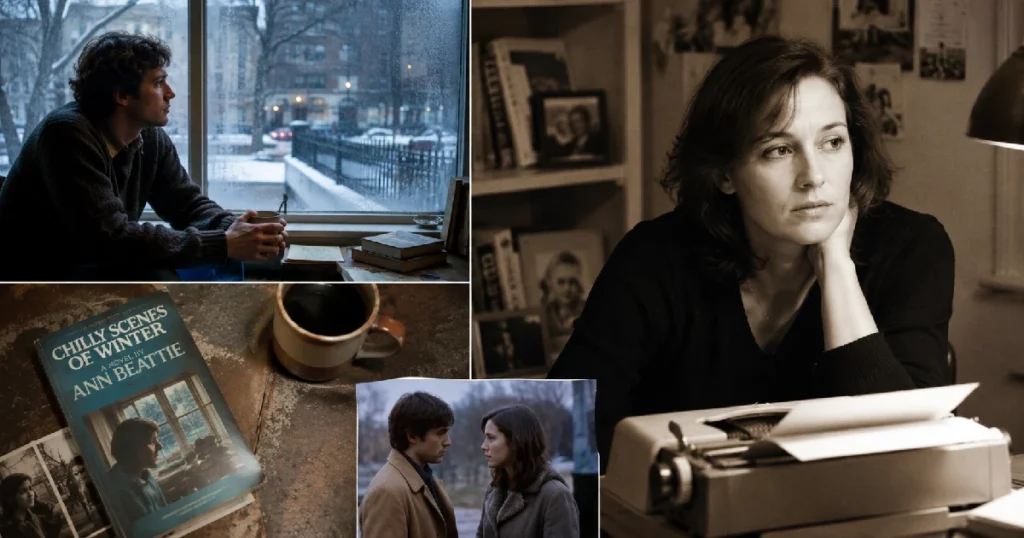
A young author named Ann Beattie sat down somewhere in the middle of the 1970s to write a book that, at first glance, seems to be about almost nothing. A man loses his girlfriend. He pouts. He responds to the news of his mother’s repeated attempts at suicide with an eerie, almost administrative composure. That is essentially the storyline. Nevertheless, Chilly Scenes of Winter has been subtly influencing readers who weren’t even alive when it first came out for decades.
Beattie had no intention of becoming a symbol. Her reputation was primarily established through short stories that appeared in The New Yorker; these pieces are known for their understated, clipped prose, which critics enjoy debating. Her debut book, Chilly Scenes of Winter, came almost as an afterthought to that reputation. It centers on Charles, a low-level civil servant who is obsessed with Laura, a woman who has abandoned him and returned to her husband. It’s a brief tale. In some way, it’s also not at all small.
When you read it now, you’ll notice how little Beattie tells you directly. She steers clear of adjectives almost on principle, much like some writers steer clear of clichés. Characters don’t express their emotions verbally. They enter rooms, take a seat, say “hi,” and the reader is left to observe the pauses in the conversation. It’s a method that shouldn’t be as effective as it is. As you watch this play out on paper, you begin to notice even the tiniest movements, such as how a camera lingers on a hand or a doorway in a movie that won’t stop.
The dialogue has its own rhythm; it is repetitive, clipped, and almost melodic. Sentences that end in “he says,” “she says,” “Sam says,” and so on accumulate until the pattern resembles a heartbeat beneath the narrative. One could easily see an editor objecting to that repetition. Apparently, Beattie did not blink.
The book also contains genuine darkness. Suicide attempts by Clara, the mother of Charles and his sister Susan, are interspersed throughout the story like unwanted weather. Charles reacts to each one with an odd, flat steadiness that is indicative of someone who has experienced too many crises to respond appropriately. Perhaps this numbness, rather than the breakup with Laura, is the true subject of the book. It almost seems as though the romantic plot is a hoax.
It’s difficult to blame Beattie for resisting being chosen to represent her generation. She seemed genuinely annoyed by the label during a conversation with the Paris Review, and there’s something admirable about that resistance. Writers are easily boxed in; after writing a compelling book about disillusioned twentysomethings, they find themselves explaining an entire era to reporters. Apparently, Beattie had no interest in that position.
Eventually, the book was adapted into a movie, which debuted in 1979 under the title Head Over Heels. According to reports, neither Beattie nor the audience enjoyed the film. Rereleased in 1982 under the original title of the book, it has since gained a small cult following. It’s the kind of film that people mention almost apologetically, as if acknowledging that they enjoy something out of style.
But it’s not the movie that stays. It’s the prose, which is succinct, almost obstinately unadorned, and in some ways more emotionally precise. At one point, Charles imagines events with Laura that never happened, like a birthday dinner, a beach trip, and a sunburn. Beattie doesn’t have to explicitly state that none of it is true. Sitting on the page is the ache.
To be honest, it’s still debatable whether Chilly Scenes of Winter qualifies as the “voice of a generation” and is probably irrelevant. It appears more obvious that Beattie managed to write about quiet family crises and heartbreak without resorting to melodrama or over-explanation, relying on readers to fill in the blanks. That restraint still feels more like a dare than a stylistic decision nearly fifty years later.
