
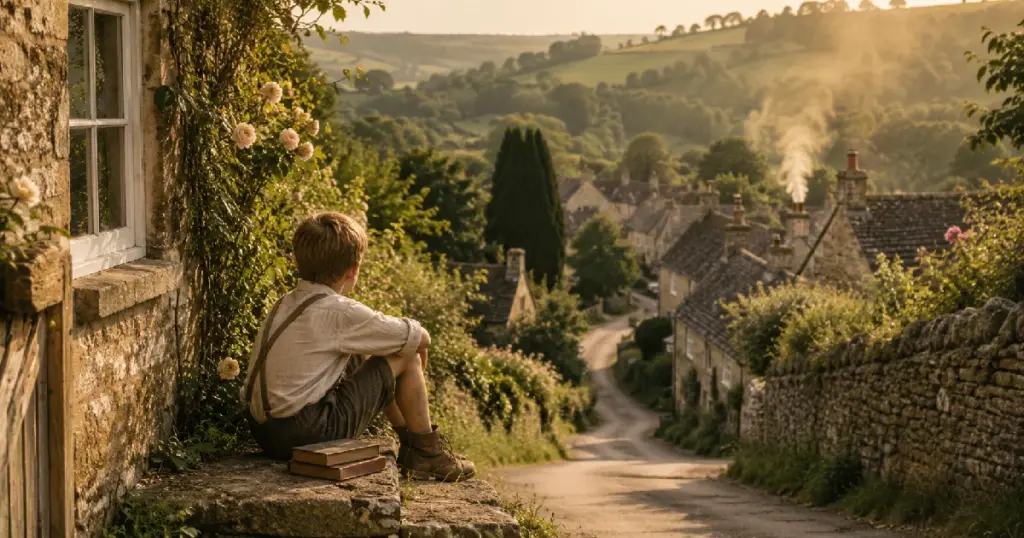
On any given afternoon, you’ll probably find someone sipping a pint of local cider at The Woolpack pub in Slad, half-reading, half-people-watching, and conscious that they’re seated in the exact location where Laurie Lee once drank. It’s a small, somewhat ridiculous ritual, but it illustrates how deeply a village’s identity was shaped by one man’s memoir. Cider with Rosie continues to draw readers to this specific area of the Cotswolds sixty-five years after it was first published, and it’s important to consider why a book about a boy’s early years in rural Gloucestershire has remained so resolutely memorable.
Born in Stroud in 1914, Lee and his mother, along with a large family of siblings and half-siblings, moved into a dilapidated cottage in the Slad Valley when he was three years old. Lee later claimed that he hardly noticed his father’s permanent departure, sending money but little else. Just that particular detail reveals something about the book’s tone: it is surprisingly tender in places you wouldn’t expect sentiment and unsentimental in others.
Now that I’m reading Cider with Rosie, it’s odd how much of it reads more like folklore than memory. At the age of three, Lee talks about standing in grass taller than his head. He recalls armistice bonfires with cinematic clarity, and he uses the same steady hand that he uses to pick blackberries and sing carols to recall village murders and neighbors who were confined to workhouses. Certain facts, he acknowledged, “may be distorted by time.” Despite this admission, he was sued for libel regarding an alleged piano factory fire, and his biographer Valerie Grove eventually proved that he had served in the Spanish Civil War. Though it’s possible that Lee didn’t care as much about this distinction as his detractors do, it’s still unclear how much of the book is memory and how much is myth-making.
The problem with Cider and Rosie is that their disagreements over factual accuracy often overlook what makes it work. The hard work is done by the prose. A few pages away from the “gaping bones” of a dead bird and a cat’s carcass covered in maggots are trees that “writhed with power” and “threw off veils of green dust.” Rot and light, side by side, without regret. The book’s enduring appeal is likely due to this juxtaposition rather than the picture-perfect depiction of rural England that appears on its covers.
In a literal sense, the village has largely disappeared. The “well-prodded horrors” Lee described have been replaced by Airbnb listings and gift shops selling his books, and cars now line streets that were once used by horses and foot traffic. However, there is a geographical resistance to complete modernization. In certain winters, snow still closes the steep lanes, forcing locals to leave on foot, just as Lee’s generation did. It’s difficult not to notice a peculiar continuity as you watch that occur, as if the valley periodically returns to its original character.
His lines are now affixed to trees and gateposts along Laurie Lee Wood and the Laurie Lee Wild Way, which wind through the hills close to Slad. A grave in the churchyard has the simple inscription, “He lies in the valley he loved.” It’s up to personal preference whether that tribute is appropriate or a little too messy, but it does convey something accurate about the man’s connection to this location. In the ensuing sequels, he famously wandered all the way to Spain and back. Nevertheless, Slad appears to be the focal point of the narrative.
Skepticism easily targets cultural nostalgia, and Cider and Rosie are accused of promoting a sanitized England that never really existed. It seems like a half-fair charge. Grief, poverty, and violence ran alongside the orchard cider and cowslips in Lee’s Slad. The book’s refusal to simplify the past is what keeps readers coming back, and in a time when neat narratives are the norm, this refusal may be precisely why the book has endured so well.
