
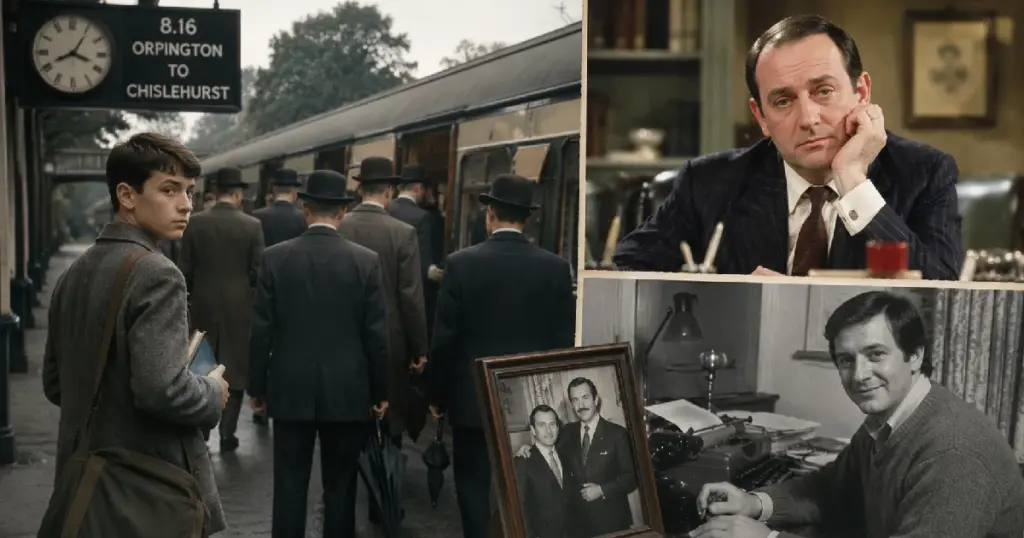
Imagine a schoolboy traveling from Orpington to Chislehurst on the 8.16 train every morning, seeing the same commuters in the same pinstripe suits press their furled umbrellas against the same seats. That boy was David Nobbs, and it’s odd to think that this brief, repetitive scene—so unremarkable that it hardly registers—became one of the most adored characters on British television. When Nobbs read a magazine article about a new jam flavor twenty years later, he couldn’t help but think of those commuters and wonder if creating a jam flavor could truly be the pinnacle of a person’s career.
That idea became Reginald Perrin, a food executive who, out of pure suburban despair, pretends to be dead. When he returns in disguise, he finds that nothing has changed from his previous life. The Fall and Rise of Reginald Perrin, which ran from 1976 to 1979, became one of the decade’s most iconic sitcoms. Leonard Rossiter portrayed him with a kind of controlled mania that made the character unforgettable. Nowadays, it’s easy to undervalue how strange that prime-time television concept was. A man making a joke out of his own suicide? Nobbs never allowed the joke to overpower the melancholy that lurked beneath it, which is why it worked.
Nobbs’s keen observation of real offices gave him an ear for workplace absurdity. Nobbs himself once sat nervously pitching the idea in a BBC executive’s office, which is where Reggie sits in the squeaky chair while his boss CJ gives his daily “I didn’t get where I am today” lecture. He even acknowledged that he was the model for the eager, empty-enthusiasm salesman character—the type of person who says something like “terrific” about dinner being ready in 45 minutes but really doesn’t mean it. Nobbs once overheard three strangers in a Leeds hotel repeating his own dialogue near a lift, watching the phrase “I didn’t get where I am today” escape into real office life. He claimed that he wanted to dance.
Nobbs had already established a more subdued reputation as one of the most dependable engine rooms in British comedy prior to Perrin. After spending all of his savings on nine unpublished plays in a bedsit in West Hampstead, he cold-called David Frost from a phone booth to write for That Was the Week That Was. From there, it was The Frost Report with John Cleese, followed by consistent work for Ronnie Barker and Ronnie Corbett, which included the show’s well-known “goodnight from me, goodnight from him” sign-off and wordplay-heavy sketches. Nobbs carried a lot of weight behind the scenes, as evidenced by Cleese’s statement that as a young writer, Nobbs actively sought out his laughter.
Some of Nobbs’s later sitcoms did struggle, and it’s possible that his kinder, more somber style just didn’t make it through the louder comedy of the 1980s. However, he regained his footing in 1989 with A Bit of a Do, a class-tension drama that attracted almost fifteen million viewers, demonstrating that the earlier instinct had not vanished but had only momentarily gone out of style.
The contrast between Nobbs and his most well-known creation is what sticks out the most when reading about him now. Nobbs claimed to be steady, married twice, financially secure, and generally free of his character’s despair, while Perrin was overcome with angst. The phrase “doing a Reggie” became commonplace in British slang to refer to pretending to be dead, but the man who coined it never experienced the urge. He claimed that writing gave him the joy that Perrin was unable to find. There’s a subtle movement in that—a writer creating a character characterized by crisis while leading a life characterized by its absence, and somehow comprehending both sufficiently to make millions of people laugh at the contrast.
