
Something intriguing occurs when you watch someone take a book out of their bag in a busy waiting area. People in their immediate vicinity notice them as they browse through their phones with that glazed look that comes with doing something you don’t truly enjoy. They appear slightly embarrassed at times. Curious at times. Every now and then, there’s a glimpse of recognition—of seeing something they used to do or always intended to start—in the manner of strangers on trains who never quite speak to one another.
Usually, none of this is noticed by the person holding the book. They’re reading.
On closer examination, this seemingly insignificant habit turns out to compound in amazing ways. The author and media strategist Ryan Holiday, who has written extensively about Stoic philosophy and daily practice, has made it a point to carry a book with him everywhere he goes, including to Disneyland, the DMV, NFL games, backstage at talks, the Grammys, and reportedly into a green room prior to surgery. He claims that he is not a speed reader. He merely fills in the blanks. Over the course of a year, every idle minute turns into a minute spent with a book in his hands, which adds up to something that most people would find genuinely hard to believe. Over the course of a year, reading for ten to fifteen minutes every day exposes the mind to over a million words, or about twenty complete books. That isn’t a productivity ploy. What to do with the moments that typically vanish into a phone screen is all that needs to be decided.
Similar actions were taken by Theodore Roosevelt, but with much less technology vying for his attention. In her account of Roosevelt’s years in the White House, Doris Kearns Goodwin recounts how he stole time to read in between appointments, bringing a book to the Executive Office and cracking it open at whatever fleeting moments the day presented. Decades later, William Howard Taft could still clearly recall it and describe it. Roosevelt read about an almost ridiculous variety of topics, including natural history, poetry, military history, novels, and philosophy. His advisors and contemporaries frequently observed that Roosevelt had a capacity for connected thought and the ability to make unexpected connections between ideas that seemed to stem directly from this breadth. Maybe that’s just the way he was made. It’s also possible that reading continuously for years on end, about everything, has an effect on the mind that nothing else can quite match.
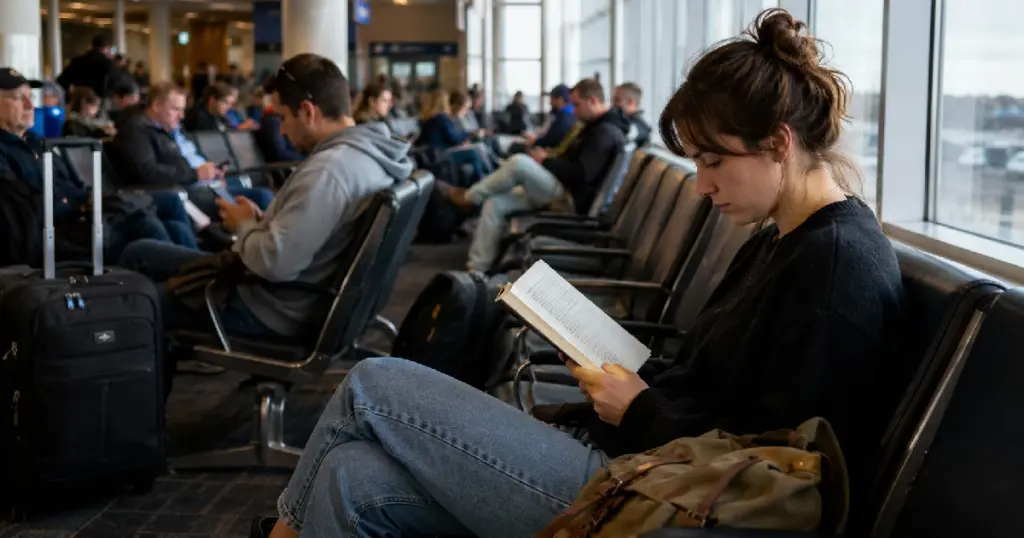
This has a physical component that is often overlooked. A certain level of calm is both necessary and produced when reading a book in a noisy or chaotic setting, such as an airport gate, a hospital lobby, or a delayed subway car. Reading reduces heart rate, draws focus inward, and produces a sort of transportable solitude that is unrelated to the actual place. When someone is reading while standing in a long line at a government office, their experience is fundamentally different from that of the person next to them, who is quietly becoming enraged at how slow everything is. The line is not shortened by the book. It renders the wait pointless.
It’s also somewhat countercultural now, which wasn’t always the case. In a world designed to seize and profit from every idle moment of attention, carrying a physical book in 2026 is a modest but sincere act of defiance. Pulling out a book is an option to choose something slower and more demanding over the phone’s practically limitless supply of content designed to keep eyes on a screen. It’s not a big gesture. A book in a bag, that is. The difference between a mind that has read fifty books and one that has watched fifty thousand short videos, however, is the result of repeatedly making that decision over the course of months and years. These minds are distinct, shaped differently, and capable of different things.
A copy of Epictetus, given to him by a Stanford professor prior to his first deployment, was credited by James Stockdale, a naval aviator who spent years as a prisoner of war in Vietnam, with keeping him functional under circumstances that would have broken other men. He eventually had no book to carry, so he carried the concepts in his mind. During his incarceration, the philosophy he had read during peacetime served as his mental framework. Of course, that is an extreme situation. The majority of people who bring a book to the grocery store are not getting ready to go to jail. However, the underlying reasoning is sound: reading creates an internal structure gradually and covertly, and that internal structure ends up mattering in ways that are difficult to anticipate and more difficult to produce rapidly.
People who carry a book with them at all times tend to have a trait that is hard to pinpoint. Perhaps not in a hurry. Different from those who are just waiting for the next thing, be present. Even when they are motionless, they seem to have somewhere to be—not an urgent place, but a genuine one. A direction is a book in a bag. It implies that there is always something worthwhile to do with the remaining time, regardless of the day’s delays, interruptions, or cancellations.
It’s a more subdued kind of preparedness than most people consider developing. However, when you see it in action, it seems a lot like freedom.