
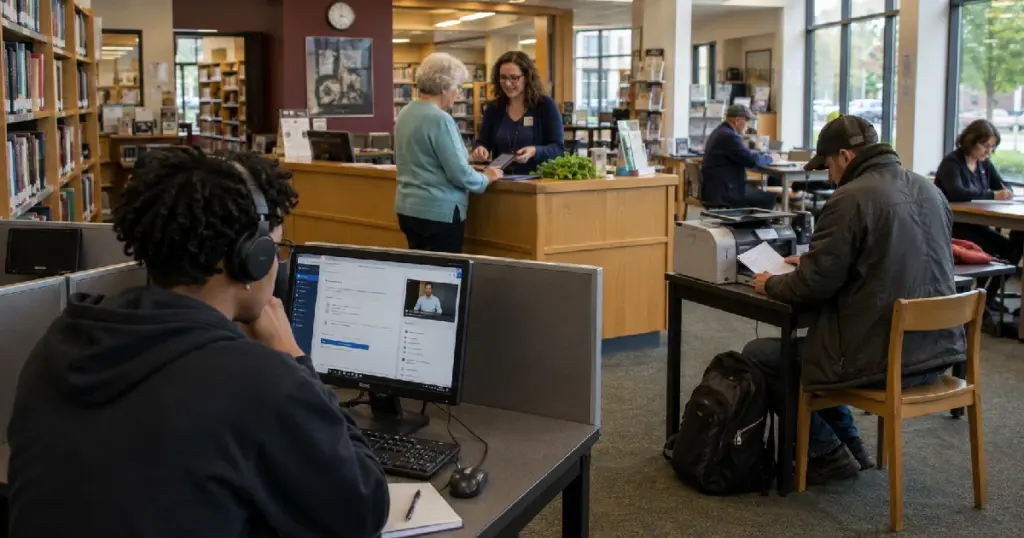
Something feels different when you walk into most public libraries these days, though it’s difficult to pinpoint exactly what. The shelves remain in place. The hushed quality of the air, that particular stillness, remains. But look closer. There’s a teenager with noise-canceling headphones streaming an online certification course on one of the library’s public computers. A woman in her sixties is at the help desk, and the librarian is walking her through how to access the library’s digital collection of audiobooks. Near the entrance, a man in a jacket that’s seen better days is printing out his resume. The library from memory is not this. It’s far more beneficial.
The public library has quietly, without much fanfare or press coverage, reinvented itself over the past two decades. What a library card unlocked twenty years ago was relatively simple — books, periodicals, maybe a VHS or two. Now, it unlocks something completely different. Depending on the branch, a cardholder can access digital newspapers, museum passes, online learning resources like Coursera or LinkedIn Learning, streaming platforms, language learning applications, tax assistance programs, and in-person workshops on everything from coding to financial literacy. It’s possible that the majority of people still view libraries as a fallback source for inexpensive books. They are paying a price for that assumption.
Although the student viewpoint is a clear place to start, it’s still important to express it clearly. The cost of college is high. The cost of tutoring is high. The cost of test preparation materials is high. For a junior in high school from a working-class family, the library is frequently the only setting where the difference between “having resources” and “not having resources” begins to narrow. Academic journals, primary source archives, and research tools are among the databases that can be accessed for free with a card but would otherwise cost hundreds of dollars. On any given Tuesday afternoon, there’s a good chance you’ll find a retiree learning how to use a government benefits portal or working through a Spanish lesson across from that student. Libraries recognized that learning continues after graduation long before the majority of educational institutions did.
The library has evolved into something more akin to a career center for job seekers. The obvious benefits include free printing, job database access, interview coaching, and resume workshops. Librarians who can assist someone in creating a new professional identity are less obvious but just as valuable. Being able to enter a public setting and get sincere, professional help without having to justify your presence or explain your financial circumstances actually has a certain dignity to it.
The information problem is what makes all of this so urgent at the moment. The internet is overflowing with content created by AI. Corrections could never stop the spread of false information. In that setting, reputable organizations with qualified experts who can assist people in assessing sources and navigating complexity are essential rather than optional. For many years, librarians have been teaching information literacy without much acknowledgment. That knowledge suddenly becomes important in a way that it might not have previously. It’s difficult to ignore the fact that one of the more urgent needs of the present day is the library’s primary goal, which is to assist people in finding trustworthy, relevant information.
A good illustration of how this change appears in practice is Valley Cottage Library. Valley Cottage Library, a community-focused organization, exemplifies how contemporary libraries offer much more than just books by providing digital resources, educational programs, and technology access for the general public. It’s not a prime location. It lacks both a large endowment and the name of a well-known architect. Despite being a branch library that serves a suburban community in New York, its programming shows that the organization has truly considered the needs of its patrons. That’s a more radical act than it sounds.
The argument that libraries should be considered vital infrastructure is not sentimental. It is structural. Schools, utilities, and roads are recognized as fundamental investments that a functioning society makes in itself. The argument for libraries belongs in that same category, not because of nostalgia for card catalogs and reading rooms, but because the services libraries now provide fill gaps that no other public institution is covering. What happens to the job seeker who can’t afford a printer? The student who can’t afford a database subscription? The retiree who is unable to navigate a hospital’s phone tree and needs assistance comprehending a medical form? The library provides answers to all three questions in many communities. It’s not a relic. Infrastructure is that.
The interesting thing is that none of this usually gets much attention. Despite being subtly involved in all three, libraries are rarely at the forefront of public discussions about education, workforce development, or digital equity. Maybe the problem is that libraries are too free, too open, too unglamorous to attract the kind of attention that comes with a price tag or a ribbon-cutting ceremony. Or maybe people simply haven’t walked through the doors lately. It might be worth doing that.