
Most readers are aware of this moment, but they hardly ever openly acknowledge it. Even though you are well aware that the character on the page has deceived, tricked, and possibly ruined someone’s life, you are still reading a book and hoping for the best. Not in spite of their actions. Occasionally, it’s practically the reason. For the past few years, publishers, writers, and now psychologists have been closely monitoring that peculiar, slightly uneasy feeling.
Although the fascination with morally reprehensible characters is not new, it has become more prominent. It becomes difficult to ignore a pattern when you visit any bookstore, spend ten minutes scrolling through BookTok, or take a quick look at the most talked-about TV dramas over the last ten years. Virtuous characters are rarely the ones that people can’t stop talking about. They are the ones who are cunning, motivated by retaliation, and follow a personal code that has nothing to do with what the majority of us would consider proper conduct. Furthermore, readers are not merely putting up with these numbers. They are loyal to them.
The degree to which this goes against our expectations of ourselves is part of what makes it worth investigating. If asked, the majority of people would say that they respect kindness, justice, and honesty. However, those same individuals will devote an entire weekend to reading about a character who doesn’t exhibit any of those traits, and they will be a little sad when the story comes to an end. It’s better to sit with that disconnect rather than try to explain it away.
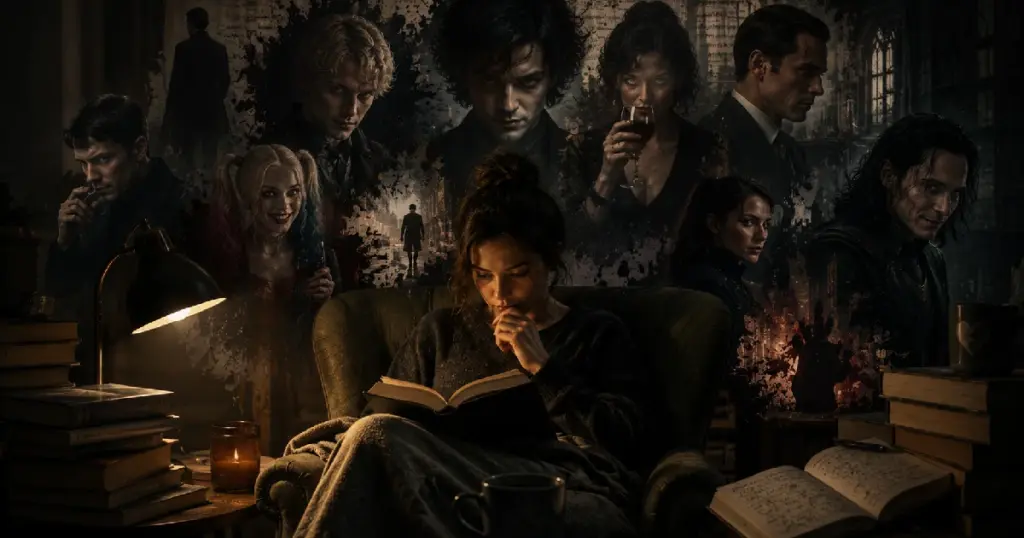
A Jungian theory-based concept known as the “shadow self” has been identified by psychologists who study how readers interact with fiction. The premise is that most people harbor thoughts, desires, and impulses that they would never act upon in real life, such as the urge to exact revenge, the allure of choosing oneself over others without repercussions, or the fantasy of saying something hurtful and getting away with it. Fiction provides a destination for those impulses. Essentially, a morally reprehensible character serves as a conduit. Through vicariously experiencing power, brutality, or moral freedom, readers can process the emotion and then go back to their regular lives without causing any harm to others. In the most traditional literary sense, it is catharsis.
However, these characters are experiencing more than just the excitement of vicarious darkness. For perfectly understandable reasons, those who truly captivate readers are typically morally reprehensible. Instead of starting out as a monster, Walter White starts out as a man who feels invisible and ashamed of a life that could have turned out differently. Although Villanelle has a violent and abandoned past, she is dangerous and unrepentant. The reader understands why Kaz Brekker from Six of Crows bases his entire identity on emotional detachment, and they experience the tragedy of it even as they witness his horrible deeds. The acts might not be justified. Seldom is the motivation. And readers typically reside in that space between a character’s actions and their motivations.
In contrast, it is important to observe how flat genuinely moral characters can feel. The pure hero archetype has become less popular in modern fiction for a reason. It turns out that reading about perfection is not very fascinating. There is no internal contradiction, no friction, and no sense that things could turn out differently. In some ways, a character who consistently makes the correct decision is less identifiable than one who makes a bad decision for a reason you can sense in your heart. Authenticity is indicated by imperfections. Readers are aware from personal experience that people are inconsistent, contradictory, and occasionally self-centered. In contrast to a morally upright protagonist, a character who reflects that feels genuine.
Narrative tension is another issue. A morally dubious or downright awful character adds unpredictability to a narrative in a way that significantly alters the reading experience. You remain interested in a character when you are genuinely unsure of whether they will stand up for someone or turn on them, when their decisions are not guided by a trustworthy moral compass. It gets more difficult to put the story down. Suddenly, readers who might otherwise skim are paying close attention, keeping an eye out for clues, and attempting to predict the next move of an unpredictable person.
In particular, Gen Z readers appear to have developed a distinct and well-documented fondness for what online communities frequently refer to as “morally grey book boyfriends”—a term that would have seemed strange to previous generations but now occupies whole sections of the internet with fervent, in-depth debate. Younger readers feel that these characters embody emotional intensity, authenticity, and the recognition that danger and desire are not always clearly distinct from one another—things that sanitized heroes just do not. Growing up in a world of carefully manicured perfection in the media may have made raw complexity seem more desirable rather than less.
All of this does not imply that readers want to act like these characters or find their behavior acceptable in real life—a distinction that frequently gets confused in cultural discussions about the subject. Distance is the foundation of the appeal. Dark themes can be explored in fiction in a safe setting with no real repercussions. Without endorsing any of it, a reader can spend three hundred pages inside the head of someone who manipulates everyone around them and leave with a better understanding of psychology, desperation, and the circumstances that lead to cruelty. Even though it feels very personal, the experience is more akin to observation than identification.
When writers grasp this, they are acting in a truly sophisticated manner. The best morally reprehensible characters are neither celebrations of their own worst tendencies nor cautionary tales. The easiest and hardest thing to do is to write them as complete human beings. Readers react with something that resembles empathy even when they know better when a writer gives a character a plausible internal logic, a backstory that explains without justification, and a set of contradictions that feel earned rather than convenient. Long after the book is closed, readers will still be thinking about these characters because of their emotional complexity.
It is difficult to ignore the fact that the characters that most people continue to talk about years after they first saw them are almost never the simple, admirable ones. They are the ones who caused you discomfort, caused you to doubt your own responses, committed an inexcusable act, and managed to hold your interest in spite of it. That enduring strength is not coincidental. It is the outcome of fiction doing what it does best, which is to reflect back to readers the aspects of human nature that are difficult to capture on camera.