
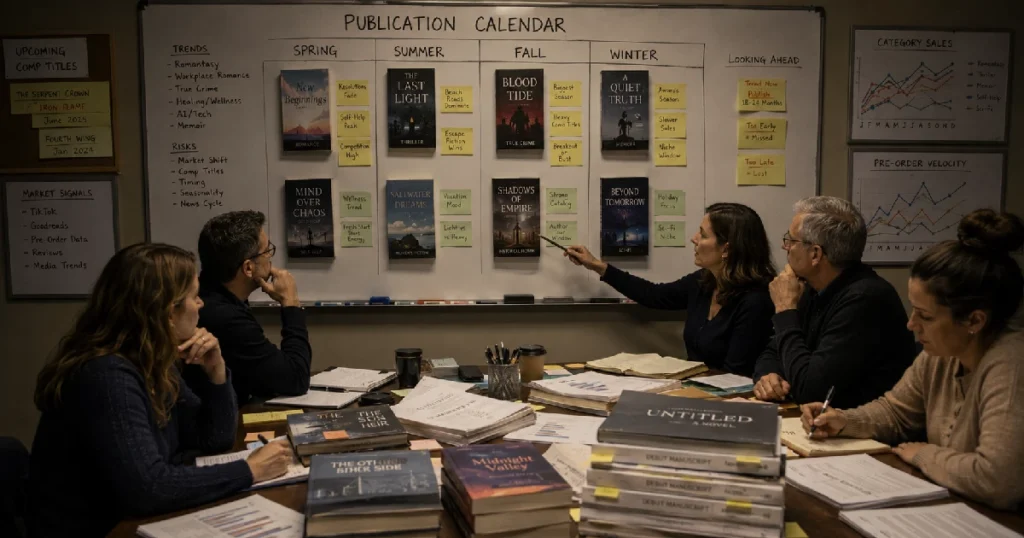
In publishing, there is a specific type of heartache that is unrelated to writing ability. A manuscript is purchased, edited, designed, and sent to retailers, only to arrive during a time when it is no longer in demand. Nothing has changed in the book. Its surroundings have. Furthermore, because publishing operates on a calendar that moves more slowly than culture, no one in the room who approved the deal two years prior could have fully anticipated the change.
It’s worthwhile to consider the true length of that gap. Nowadays, it usually takes twelve to twenty-four months for a book to be published, though it can take longer for debut fiction that has undergone several rounds of editing. This implies that an editor approving a manuscript during the acquisitions meeting is not responding to current reader preferences. Based on trend lines that could bend in any direction, they are predicting what readers will want in a year and a half. It’s a peculiar form of gambling, disguised as comp titles and profit-and-loss spreadsheets, but it’s still a gamble.
Perhaps the best illustration of how this manifests itself is found in romance and its derivatives. Publishers rush to acquire more of a subgenre when it becomes popular, such as dragons and fae courts a few years ago or workplace romance before that, knowing full well that by the time those new titles actually print, the trend may have significantly cooled. Readers are quick to move on. Publishing companies are unable to. Even if an editor sees the wave cresting in real time, they may still need to make a decision because they know the book won’t be released until the wave has probably broken.
This risk is present in nonfiction as well, perhaps even more so. A business book riding a specific economic mood, a memoir linked to a news cycle, or a political title wagering on the stability of an administration’s popularity are all as much bets against the calendar as they are bets on content. It’s similar to watching fireworks go off after the crowd has already left when a topical book is released eighteen months after the event that inspired it. Often, the craftsmanship remains intact. Unfortunately, the audience has moved on to something completely different.
The opposite issue, which receives less attention, is a book that arrives too early. Smaller, more skeptical circles are often the first to adopt ideas that eventually become mainstream, and a manuscript that is published before its audience is ready may go unnoticed but turn out to be prophetic in retrospect. Even when the underlying judgment was sound, publishers seldom receive credit for early instincts that didn’t work out commercially. Being correct too soon is not rewarded by the market. It hardly puts up with it.
Another level of risk that is completely unrelated to cultural relevance is added by seasonal slotting. Fall is when big commercial fiction tends to congregate, directly competing with other major releases from the same few best-selling authors that everyone is already familiar with. The self-improvement crowd is frequently drawn to spring, riding the momentum of the New Year’s resolution, which by March has typically subsided into background noise. Summertime is a time for escape. If a serious, ambitious book is placed in the wrong slot, it may find itself buried beneath a fall lineup full of well-known titles or competing with beach reads it was never designed to compete with.
All of this does not imply that quality is unimportant. It obviously does—no matter how strategically placed, a mediocre book is rarely saved by good timing. However, it’s difficult to ignore how many truly excellent books subtly perform poorly for reasons that have nothing to do with their sentences and everything to do with an uncontrollable calendar. Through meticulous season planning and trend forecasting, publishers attempt to control this risk, and occasionally they succeed. Sometimes a book that everyone in the editorial meeting loved just shows up eighteen months too early or too late, and there isn’t a revision that addresses the timing issue.
The majority of what remains is a type of professional humility that is rarely discussed. In essence, editors, agents, and marketing teams are placing bets on the future sentiment of a nation that they are unable to fully forecast. In certain years, their guesses come true and a book ends up being exactly what readers needed. In other years, a truly excellent manuscript simply misses its opportunity completely, and there is seldom a clear explanation other than bad luck and an impatient calendar.